

Richard independently publishes Economics Savvy and has owned and used PowerX Optimizer since 2020. He shares first-hand observations about its workflow, features, limitations, and trading risk.
Fewer than 20% of retail traders conduct any formal review of their tools or education habits at the end of a calendar year — yet the traders who do tend to enter the next year with measurably clearer decision frameworks. Year-end trading prep isn’t a ritual for institutional desks alone. For individual traders at any experience level, a disciplined review of your tools and education plan before January arrives is one of the most practical steps you can take.
Key Takeaways
- A year-end review of your trading tools and education plan reduces friction and blind spots heading into the new year.
- Evaluate software on workflow efficiency, signal reliability, and whether it still matches your current strategy — not just familiarity.
- Education gaps compound over time; identifying them once a year is more effective than reacting to losses.
- Risk management tools and rules deserve their own audit, separate from charting or scanning software.
- Structured education resources — audiobooks, courses, and guided frameworks — tend to produce more consistent learning outcomes than informal browsing.
- The cost of keeping the wrong tool is not just financial; it includes attention, time, and missed clarity.
- Trading involves substantial risk of loss; no tool or education resource eliminates that risk.
What Does a Year-End Trading Prep Actually Involve?
Year-end trading prep means conducting a structured, honest audit of every element that shapes how you trade: the software you rely on, the education you consumed (or skipped), the risk rules you followed (or bent), and the gaps that cost you clarity or capital. It is not a vague resolution — it is a checklist-driven process with specific questions attached to each category.
The goal is not to grade yourself harshly. It is to arrive at January with a clear picture of what is working, what needs replacing, and what was simply never addressed. Most traders accumulate tools and habits the way desks accumulate paper — gradually, without intention, until the clutter is the workflow.
A practical year-end review covers four domains: trading software and platforms, education and skill development, risk management rules and tools, and data or information sources. Each deserves its own set of questions, not a single pass.
How Do You Audit Your Trading Software and Platforms?
Start with a blunt question: does your current software actually match the strategy you are running, or does it match the strategy you were running two years ago? Tools accumulate inertia. Traders often keep platforms out of familiarity long after the platform has stopped serving their actual workflow.
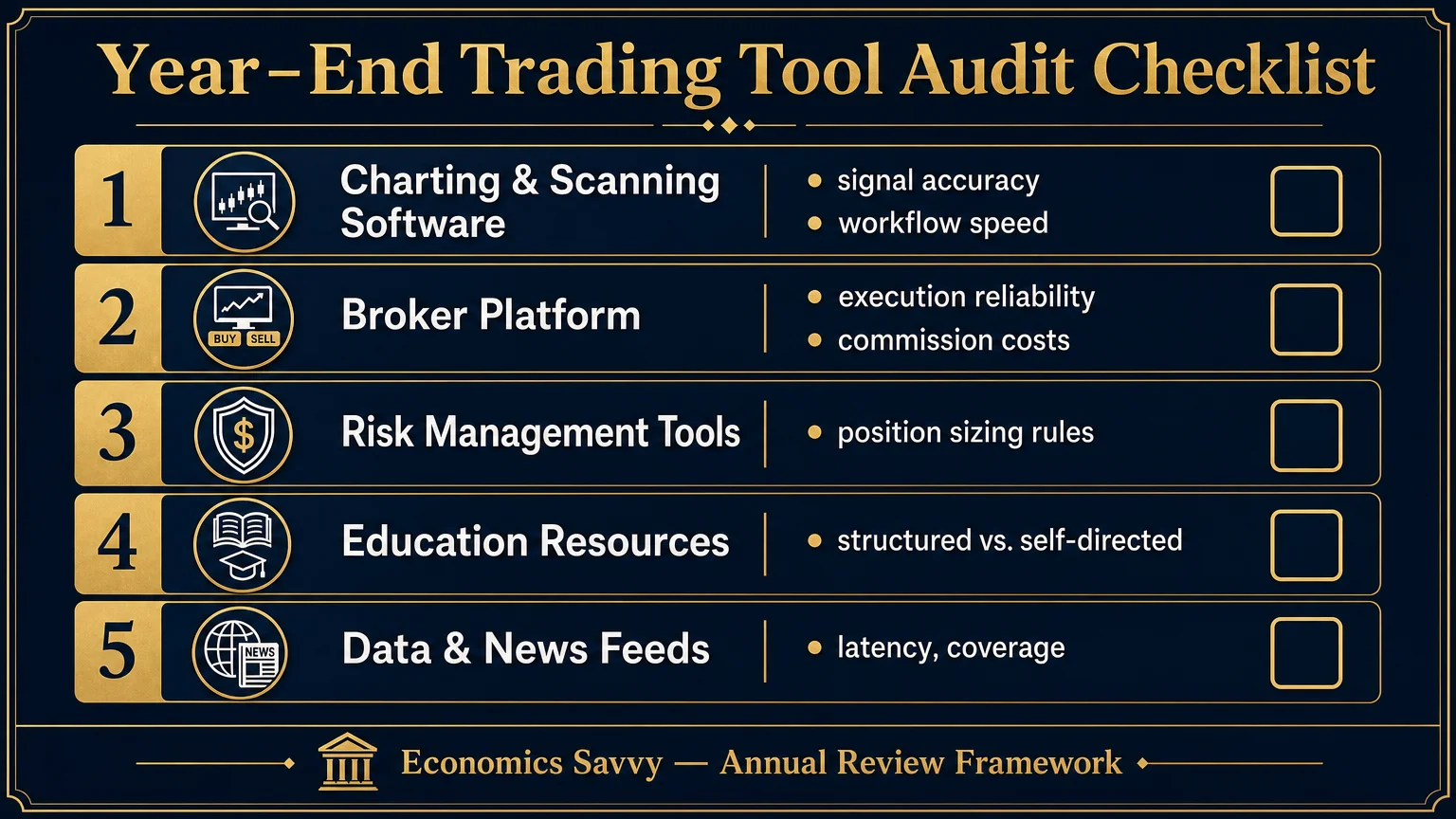
For each platform or tool in your stack, work through these audit questions:
- Signal quality: Are the signals or scans this tool generates still aligned with your entry criteria? Have you verified that alignment recently, or assumed it?
- Workflow speed: Does the tool reduce decision time, or does it add steps? A scanner that requires manual cross-referencing with three other tabs is not saving time.
- Cost relative to use: Are you paying for features you have not opened in six months?
- Integration: Does the tool communicate cleanly with your broker platform, or does every trade require manual re-entry of data?
For traders using dedicated scanning and strategy software like PowerX Optimizer, the year-end review is a good time to revisit whether the software’s built-in criteria still align with your risk tolerance and position sizing rules. A side-by-side comparison of your current platform against alternatives can also surface whether familiarity has become a substitute for fit — the PowerX Optimizer vs. thinkorswim comparison is one example of how that kind of structured comparison can clarify tradeoffs.
If you are evaluating options-specific tools for the first time or considering an upgrade, reviewing what features matter most before committing is worth the time — what to look for in options trading software for beginners offers a grounded starting framework.
How Should You Review Your Trading Education Plan?
Most traders do not have an education plan — they have an education habit, which is a different thing. Habits tend to be reactive: you watch a video after a losing trade, read an article when a topic surfaces on social media, or skim a book chapter when motivation is high. A plan is proactive, sequential, and tied to specific skill gaps.

The year-end review is the right moment to ask: what did you actually learn this year, and what did you intend to learn but never got to? Write both lists. The gap between them is your 2026 education plan.
When assessing education resources, distinguish between formats:
| Format | Strength | Limitation |
|---|---|---|
| Video courses | Visual, structured | Can feel passive without application |
| Audiobooks | Accessible, efficient for concepts | Less suited to technical chart analysis |
| Live webinars | Interactive, timely | Dependent on schedule, hard to revisit |
| Self-directed reading | Flexible | Easy to skip; no accountability |
| Mentorship / coaching | High accountability | Cost and availability vary |
Structured resources tend to outperform informal browsing for foundational concepts. The Financial Fortress audiobook from Rockwell Trading is one example of a format-specific resource worth evaluating if your education gaps lean toward financial mindset and risk psychology rather than pure technical mechanics.
For traders who have been active for a year or more, the education review should also include an honest assessment of which concepts you understand intellectually but have not applied consistently. Understanding position sizing and applying it under pressure are not the same skill.
What Risk Management Tools and Rules Need Annual Review?
Risk management is the category most traders review least — often because the rules feel settled, or because reviewing them requires acknowledging where they were broken. Both are reasons to do it anyway.
An annual risk management audit should cover:
- Position sizing rules: Are your current rules still calibrated to your actual account size and risk tolerance, or were they set when your account was a different size?
- Maximum loss thresholds: Do you have a defined daily or weekly loss limit? Was it respected this year?
- Stop-loss discipline: Review a sample of your closed trades. Were stops placed where your rules dictated, or were they moved under pressure?
- Correlation risk: Did you hold multiple positions that moved together in the same direction during a drawdown? If so, your diversification rules may need tightening.
For a grounded overview of the risks inherent in stock and options trading — particularly for traders who may be newer to the asset class — what new traders must know about stock and options trading risk covers the foundational concepts without overstating or understating the hazards involved.
It is also worth reviewing how your tools performed during volatile periods. How trading software workflow changes in a volatile market is a relevant read if your platform felt unreliable or slow during high-volatility sessions this year.
Year-End Trading Prep: What Does a Complete Review Checklist Look Like?
A complete year-end trading prep review, condensed into a working checklist:
Software and Platforms
- List every tool currently in use and its monthly or annual cost
- Identify tools used fewer than once per week — evaluate whether to keep or cancel
- Compare current platform features against your actual strategy requirements
- Note any friction points that slowed execution or added manual steps
Education
- List courses, books, or resources completed this year
- Identify skill gaps that produced real losses or missed opportunities
- Select one to two structured resources to complete before Q2 2026
- Schedule learning time in your calendar — treat it as non-negotiable
Risk Management
- Review position sizing rules against current account size
- Audit a sample of trades for stop-loss compliance
- Confirm maximum loss thresholds are still appropriate
- Document any rule violations and the context around them
Data and Information Sources
- Identify which news or data sources actually informed good decisions
- Remove sources that created noise without signal
- Confirm data feed latency is acceptable for your trading style
Closing Thoughts
Year-end trading prep — reviewing your tools and education plan with genuine rigor — is one of the few high-leverage activities available to individual traders that costs nothing but time and honesty. The traders who treat this review as optional tend to carry the same friction, the same knowledge gaps, and the same misaligned tools into each new year.
The checklist above is a starting point, not a prescription. Adapt it to your actual situation, your current strategy, and the specific gaps this year surfaced. Then act on it before January’s first trading week arrives.
For a closer look at how one specific tool holds up under daily use, the one-month daily observations on PowerX Optimizer offers a grounded, practical perspective worth reading as part of your software evaluation.
Trading stocks and options involves substantial risk of loss and is not suitable for all investors. Nothing on Economics Savvy constitutes personalized investment advice. Economics Savvy may earn a commission on purchases made through affiliate links at no additional cost to you.
Frequently Asked Questions
How long should a year-end trading review take?
A thorough review typically takes two to four hours if you have organized trade records and a list of your current tools. Spreading it across two sessions — one for software and risk, one for education — tends to produce more honest results than rushing through everything at once.
Should I cancel tools I haven't used much this year?
Generally, yes. If a tool has not contributed to a trade decision in six months, it is either redundant or misaligned with your current strategy. Keeping unused tools adds cost and cognitive clutter without benefit.
Is there a right time of year to do this review?
The final two weeks of December work well for most traders because market volume typically slows, creating natural space for reflection. Some traders prefer early January before the new year's volatility picks up. Either window is effective; consistency matters more than timing.
How do I identify gaps in my trading education?
Review your losing trades from the year and look for patterns. If the same type of mistake recurs — misreading options Greeks, entering too early, ignoring sector correlation — that pattern points directly to an education gap worth addressing.
Does reviewing my tools actually improve trading performance?
No tool review guarantees better performance, and trading always involves substantial risk of loss. What a structured review does is reduce avoidable friction — the kind that comes from using mismatched software, skipping education, or operating with rules you haven't revisited in years. Clearer systems reduce unnecessary errors; they do not eliminate market risk.
What should I look for when comparing trading software options?
Focus on workflow fit over feature count. The relevant questions are: does this tool surface the information I need at the moment I need it, does it integrate with my broker, and does its signal logic match my strategy criteria? [A verified breakdown of PowerX Optimizer's cost](/blog/how-much-does-powerx-optimizer-cost-a-verified-breakdown/) is a useful reference if cost transparency is part of your evaluation.
How often should I update my education plan during the year?
A full review once a year is the minimum. A lighter quarterly check-in — noting whether you are on track with planned resources and whether new gaps have emerged — keeps the plan from going stale between annual reviews.
Richard independently publishes Economics Savvy and has owned and used PowerX Optimizer since 2020. He shares first-hand observations about its workflow, features, limitations, and trading risk.