

Richard independently publishes Economics Savvy and has owned and used PowerX Optimizer since 2020. He shares first-hand observations about its workflow, features, limitations, and trading risk.
Trading software pricing spans an enormous range — from $0 broker-bundled platforms to institutional tools costing over $1,000 per month. Understanding the full cost breakdown before committing to any platform is one of the most practical steps a trader can take in 2026.
Key Takeaways
- Trading software costs vary from free to $1,000+ per month depending on features, data access, and support.
- “Free” platforms often carry hidden costs: delayed data, limited scanners, or upsell funnels.
- Standalone paid platforms typically range from $20 to $300/month for retail traders.
- All-in-one education and software bundles are sometimes priced as one-time or annual fees rather than monthly subscriptions.
- Data feed and exchange fees are separate from platform fees and are frequently overlooked.
- The right cost tier depends on trading style, frequency, and the specific tools a trader actually uses.
- Always verify current pricing directly with the vendor — promotional pricing changes frequently.
- Trading involves substantial risk of loss; software costs are a fixed expense regardless of performance.
What Are the Main Pricing Tiers for Trading Software?
Trading software generally falls into five cost tiers, each with meaningfully different capabilities. At the base level, broker-bundled platforms like thinkorswim (TD Ameritrade/Schwab) and Webull are available at no direct charge to account holders. Moving up, basic standalone tools run roughly $20–$80/month. Mid-tier professional scanners and analytical platforms typically land between $100–$300/month. Institutional-grade systems can exceed $400–$1,000/month. Finally, all-in-one education-plus-software bundles are often sold as one-time purchases or annual subscriptions rather than monthly fees.
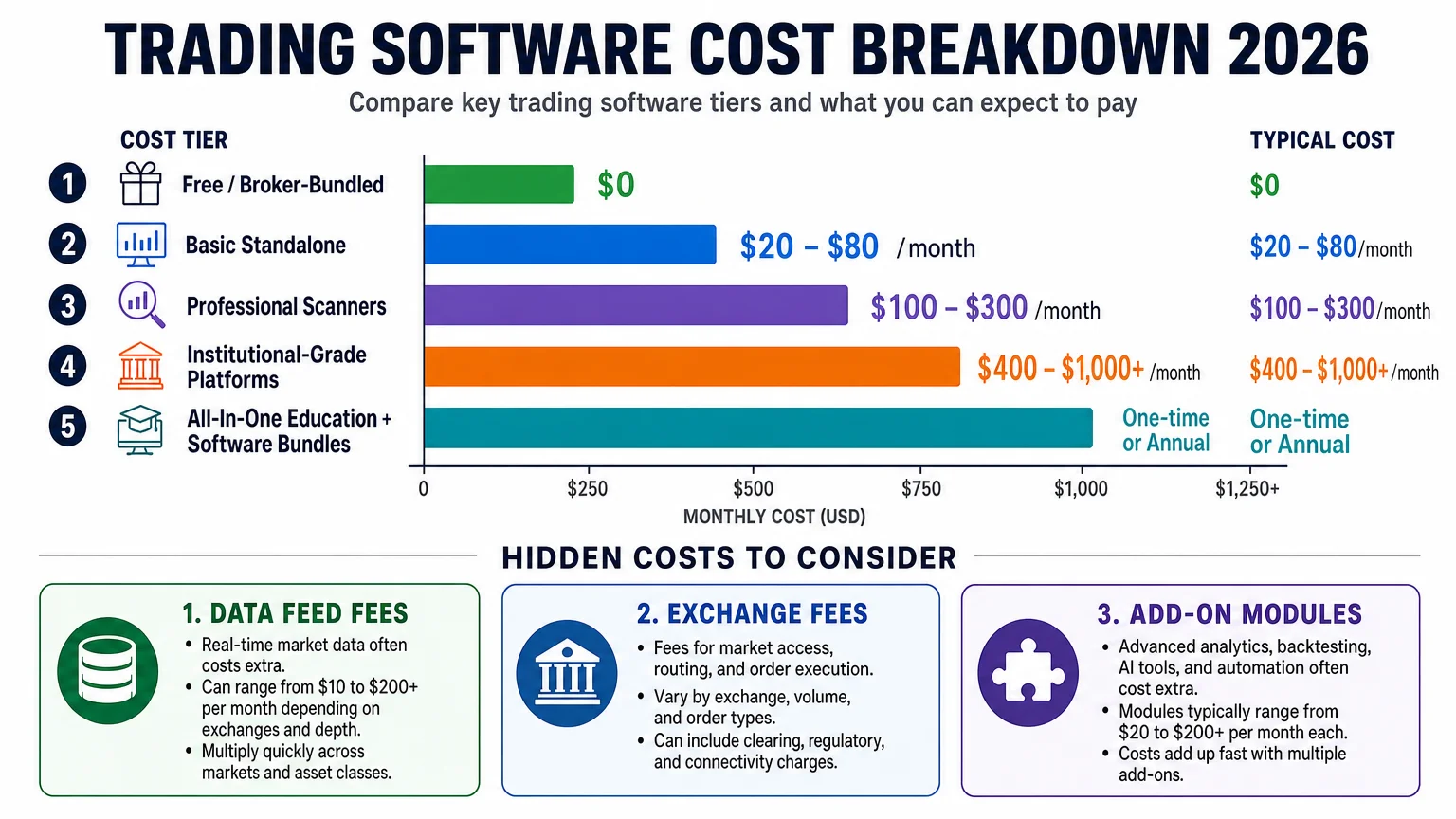
Each tier reflects a different value proposition. Free broker tools prioritize account retention over feature depth. Mid-tier platforms target active retail traders who need real-time scanning, backtesting, or defined strategy signals. The institutional tier serves professionals managing significant capital who require direct market access, advanced order routing, and premium data. Understanding which tier matches your actual trading activity — not your aspirational activity — is the most cost-effective starting point.
What Hidden Costs Do Traders Frequently Overlook?
The sticker price of a trading platform rarely tells the full story. Several recurring charges sit outside the subscription line item and can meaningfully increase total monthly spend.
Data feed fees are among the most common surprises. Real-time Level 1 and Level 2 quotes from major exchanges (NYSE, NASDAQ, CBOE) are licensed separately. Depending on the platform and data provider, these fees range from $10 to $100+ per month per exchange. Some platforms bundle one exchange feed; others require traders to subscribe individually.
Exchange fees for options are charged per contract on most retail platforms and are distinct from the platform subscription. At $0.50–$0.65 per contract on many brokers, these add up quickly for active options traders.
Add-on modules — including earnings analysis tools, volatility dashboards, and strategy-specific scanners — are frequently sold as upgrades on top of a base subscription. A platform advertised at $49/month may require an additional $30–$50/month in modules before it delivers the functionality shown in marketing materials.
Training and education costs are sometimes bundled with software but often sold separately. A platform may be affordable on its own, but the accompanying course library, coaching calls, or webinar access can represent a significant additional investment.
For traders evaluating risk across all dimensions, the article Stock and Options Trading Risk: What New Traders Must Know provides useful context on how fixed software costs interact with variable trading losses.
How Do Free and Paid Platforms Actually Compare?
The honest answer is that free platforms are genuinely capable for many traders — but with specific, material limitations that matter depending on how you trade.
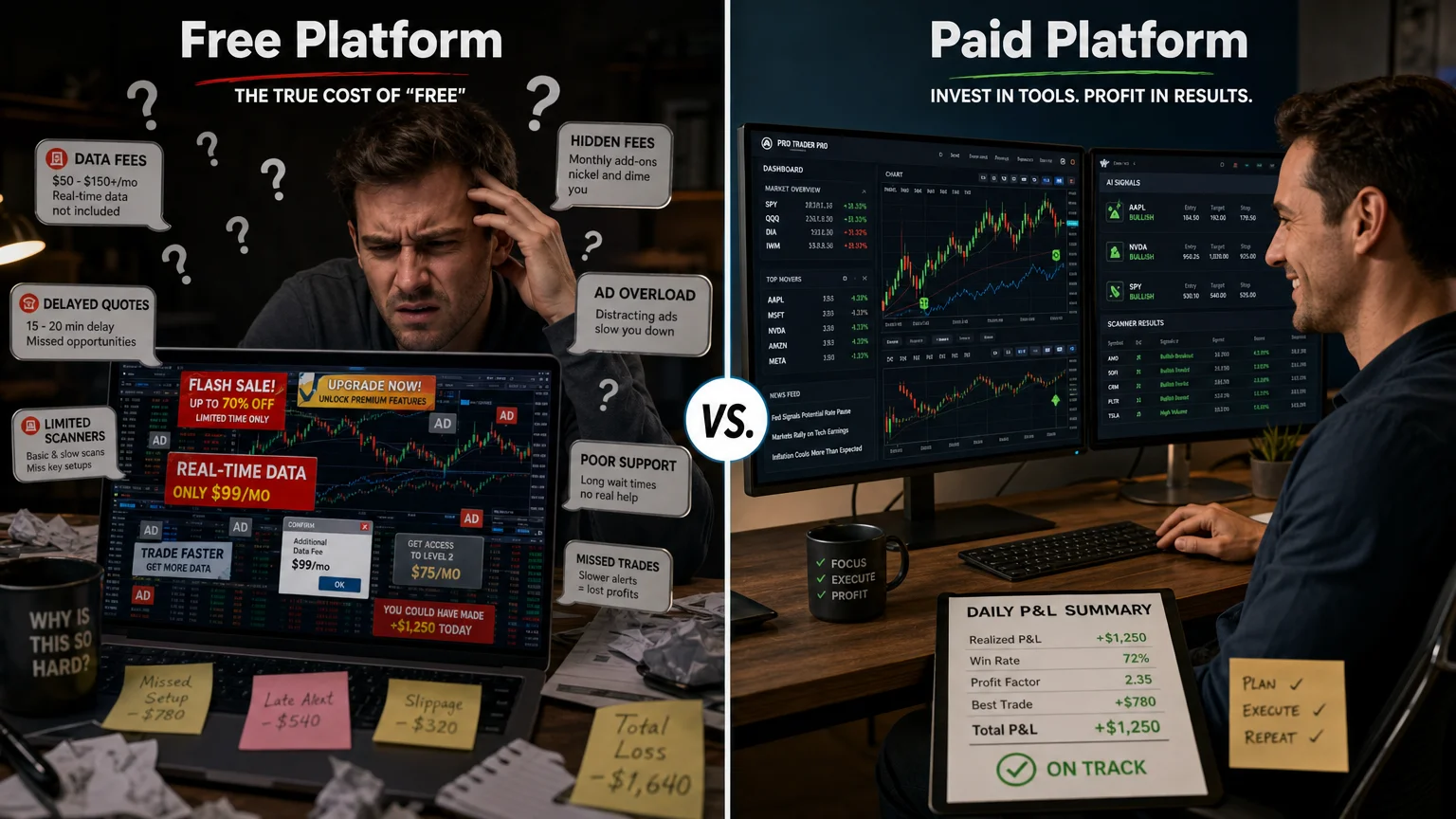
Free broker-bundled platforms typically offer real-time quotes (within the broker’s own ecosystem), basic charting, and standard order types. What they generally lack: independent scanning across multiple brokers, automated signal generation, backtesting engines, and integrated trade management workflows. For a trader who executes a handful of trades per month based on their own research, a free platform may be entirely sufficient.
Paid platforms justify their cost primarily through time savings and signal quality. A scanner that surfaces five high-probability setups from 5,000 stocks in under a minute replaces hours of manual screening. For traders who use PowerX Optimizer daily, the workflow compression alone is frequently cited as the primary value driver — not the signals themselves, but the reduction in research time.
The comparison is not simply free versus paid. It is: what is your time worth, and what does the software actually replace in your process?
| Feature | Free (Broker-Bundled) | Paid Mid-Tier ($100–$300/mo) | All-in-One Bundle |
|---|---|---|---|
| Real-time quotes | ✓ (broker only) | ✓ (multi-source) | Varies |
| Stock/options scanner | Basic | Advanced | Integrated |
| Backtesting | Limited/none | Yes | Often included |
| Strategy signals | No | Yes (some) | Yes |
| Education content | No | Rarely | Yes |
| Support | Broker support | Platform support | Dedicated |
| Pricing model | Free | Monthly subscription | One-time or annual |
What Does All-In-One Trading Software Typically Cost?
All-in-one platforms — those combining scanning, signals, trade management, and education — are priced differently from pure software subscriptions. Rather than a monthly SaaS fee, many are sold as one-time license purchases or annual memberships, sometimes with a recurring data or support component.
PowerX Optimizer, developed by Rockwell Trading, is one example in this category. For verified current pricing on that specific platform, the most reliable source is the detailed cost breakdown for PowerX Optimizer, which reflects the current offer structure directly from the vendor. Pricing in this segment changes periodically, and independently verified figures are more reliable than any third-party estimate.
All-in-one bundles tend to appeal to traders who want a defined system rather than assembling components from multiple vendors. The trade-off is less flexibility — you are committing to one methodology — but the total cost of ownership is often lower than subscribing to a scanner, a data feed, a charting platform, and an education library separately.
How Should Traders Evaluate Cost Against Value?
Cost-per-feature comparisons are useful, but the more meaningful question is cost relative to how the tool changes trading behavior. A $200/month platform that reduces impulsive trades or improves position sizing discipline has a different economic profile than a $200/month platform that simply displays the same information a trader already had.
A few practical evaluation criteria:
- Does it replace something you are currently paying for? If a new platform consolidates three existing subscriptions, the net cost may be lower than it appears.
- Does it reduce time spent on research? Time has a cost. Quantifying hours saved per week against the monthly fee is a straightforward calculation.
- Is there a trial period or money-back guarantee? Reputable platforms typically offer some form of risk-free evaluation window. Verify the terms before purchasing.
- What is the total cost including data feeds? Always ask vendors what data subscriptions are required for full functionality.
Traders interested in a direct platform comparison can review PowerX Optimizer vs. thinkorswim for a side-by-side look at how a paid all-in-one platform compares to a free broker-bundled tool across specific feature categories.
Are Trading Education Costs Separate From Software Costs?
Often, yes. Software and education are bundled in some products and sold independently in others. This distinction matters because education costs can be substantial — structured trading courses from reputable providers frequently run $500–$3,000 or more as standalone purchases.
When software and education are bundled, the effective per-unit cost of each component is lower, but the upfront investment is higher. Traders who already have a defined methodology may find standalone software more cost-efficient. Those who are still developing their approach may find that bundled education justifies the premium.
The Financial Fortress audiobook from Rockwell Trading is an example of a lower-cost educational entry point that covers trading mindset and financial planning concepts without requiring a full software commitment. It represents a different cost tier than a full platform subscription and serves a different purpose.
For a broader overview of structured learning resources, Stock Trading Education covers the range of options available to retail traders at different experience levels.
Final Thoughts
The full cost of trading software is almost always higher than the advertised subscription price once data feeds, add-on modules, and education costs are accounted for. The most useful exercise before purchasing any platform is to build a complete monthly cost estimate — subscription, data, and any required add-ons — and compare that total against the specific workflow problems the software solves.
For traders evaluating specific platforms, the PowerX Optimizer review offers a detailed look at what one all-in-one platform actually does, who it is designed for, and where its limitations lie. That kind of feature-level transparency is more useful than price comparisons alone.
Trading stocks and options involves substantial risk of loss and is not suitable for all investors. Software costs are fixed expenses incurred regardless of trading performance. Always verify current pricing directly with the vendor before purchasing.
Frequently Asked Questions
How much does trading software cost on average in 2026?
Retail trading software ranges from free (broker-bundled platforms) to $300+/month for professional-grade scanners and analytical tools. All-in-one education and software bundles are often priced as one-time or annual purchases. The average active retail trader using a paid standalone platform typically spends $50–$200/month before data feed costs.
Are there any genuinely free trading platforms worth using?
Yes. Broker-bundled platforms like thinkorswim offer real-time charting, options analysis, and paper trading at no direct cost to account holders. They are legitimate tools with real capabilities, though they lack the independent scanning and automated signal features found in paid platforms.
What are data feed fees and do I have to pay them?
Data feed fees are licensing charges from stock exchanges for real-time quote access. Many platforms include one exchange feed in their base subscription but charge separately for others. Depending on the exchanges you trade, these fees can add $10–$100+/month to your total cost.
Is PowerX Optimizer a monthly subscription or a one-time purchase?
PowerX Optimizer's pricing structure should be verified directly with Rockwell Trading, as offer terms change periodically. For the most current verified breakdown, see [How Much Does PowerX Optimizer Cost?](/blog/how-much-does-powerx-optimizer-cost-a-verified-breakdown/).
Can trading software improve my results?
Trading software can improve efficiency, reduce research time, and help enforce a consistent process — but it does not guarantee profitable outcomes. Trading stocks and options involves substantial risk of loss, and no software eliminates that risk. Results depend on the trader's decisions, discipline, and market conditions, not the platform alone.
What should I look for in a trading software trial period?
Verify the length of the trial, whether a credit card is required upfront, and the exact cancellation process. Test the features you will actually use daily — not the most impressive demo features. Confirm whether data feed costs apply during the trial period.
Is it worth paying for trading software if I am a beginner?
For most beginners, starting with a free broker-bundled platform while investing in structured education first is a more cost-effective sequence. Paid software delivers the most value when a trader already has a defined strategy to execute — otherwise, the signals and scanners may create noise rather than clarity.
Richard independently publishes Economics Savvy and has owned and used PowerX Optimizer since 2020. He shares first-hand observations about its workflow, features, limitations, and trading risk.