

Economics Savvy provides independent, risk-aware reviews of trading software and education based on daily use. Affiliate links are clearly disclosed; content is educational, not investment advice.
Two of the most frequently discussed platforms among retail traders in 2026 are PowerX Optimizer and Thinkorswim — yet they serve meaningfully different purposes. This comparison examines what each platform actually does, who it is built for, and where the meaningful differences lie, so you can make an informed decision rather than a default one.
Quick Answer: PowerX Optimizer is a structured screening and strategy tool designed around a specific rule-based trading method, while Thinkorswim is a full-featured brokerage platform with broad charting, analysis, and execution capabilities. They are not direct substitutes — the better choice depends on whether you want a guided framework or an open-ended professional toolkit.
Key Takeaways
- PowerX Optimizer is developed by Rockwell Trading and built around a defined trading strategy with pre-set screening criteria.
- Thinkorswim (now part of Charles Schwab following its TD Ameritrade acquisition) is a comprehensive brokerage platform available at no additional software cost to account holders.
- PowerX Optimizer carries a subscription cost; Thinkorswim is included with a Schwab brokerage account.
- PowerX Optimizer reduces decision complexity through a structured workflow; Thinkorswim offers near-unlimited customization at the cost of a steeper learning curve.
- Neither platform guarantees trading results. Both carry the inherent risks of stock and options trading.
- Traders new to systematic methods may find PowerX Optimizer’s guided approach easier to follow consistently.
- Experienced traders who need advanced scripting, options analysis, or multi-asset execution may prefer Thinkorswim’s depth.
- The two platforms are not mutually exclusive — some traders use both in a complementary workflow.
What Is PowerX Optimizer and What Does It Actually Do?
PowerX Optimizer is a desktop software application created by Rockwell Trading. Its core function is to scan a watchlist of stocks and ETFs and surface candidates that meet a specific set of technical criteria aligned with Rockwell Trading’s PowerX Strategy — a rule-based approach to trading stocks and options.
Rather than presenting raw data for a trader to interpret freely, the platform outputs a prioritized list of trade candidates with pre-calculated entry, stop-loss, and profit-target levels. This structure is deliberate: the software is designed to reduce the number of subjective decisions a trader has to make in real time. For busy adults who want a repeatable process rather than hours of chart analysis, that constraint is a feature, not a limitation.
The platform also includes educational context from Rockwell Trading, making it part of a broader learning ecosystem rather than a standalone tool. Readers interested in how structured trading education fits into this workflow can explore more on the Stock Trading Education section of this site.
What Is Thinkorswim and Who Owns It Now?
Thinkorswim began as an independent options trading platform before being acquired by TD Ameritrade, which was itself acquired by Charles Schwab in 2020. As of 2026, Thinkorswim is available as part of the Schwab trading suite — accessible to anyone with a Schwab brokerage account at no separate software charge.
The platform is widely regarded as one of the most capable retail trading environments available. It supports equities, options, futures, and forex. Its charting engine is highly configurable, and its proprietary scripting language, thinkScript, allows traders to build custom indicators, scanners, and automated alerts from scratch. The options analysis tools — including probability cones, risk profiles, and multi-leg strategy builders — are among the most detailed available outside institutional platforms.
The trade-off is complexity. Thinkorswim’s interface is dense, and new traders often report a significant learning curve before they can use it efficiently. The platform rewards those who invest time in learning it, but it does not provide a built-in strategic framework the way PowerX Optimizer does.
PowerX Optimizer vs. Thinkorswim: A Direct Feature Comparison
The clearest way to understand the difference between these two platforms is to compare them across the dimensions that matter most to retail traders.
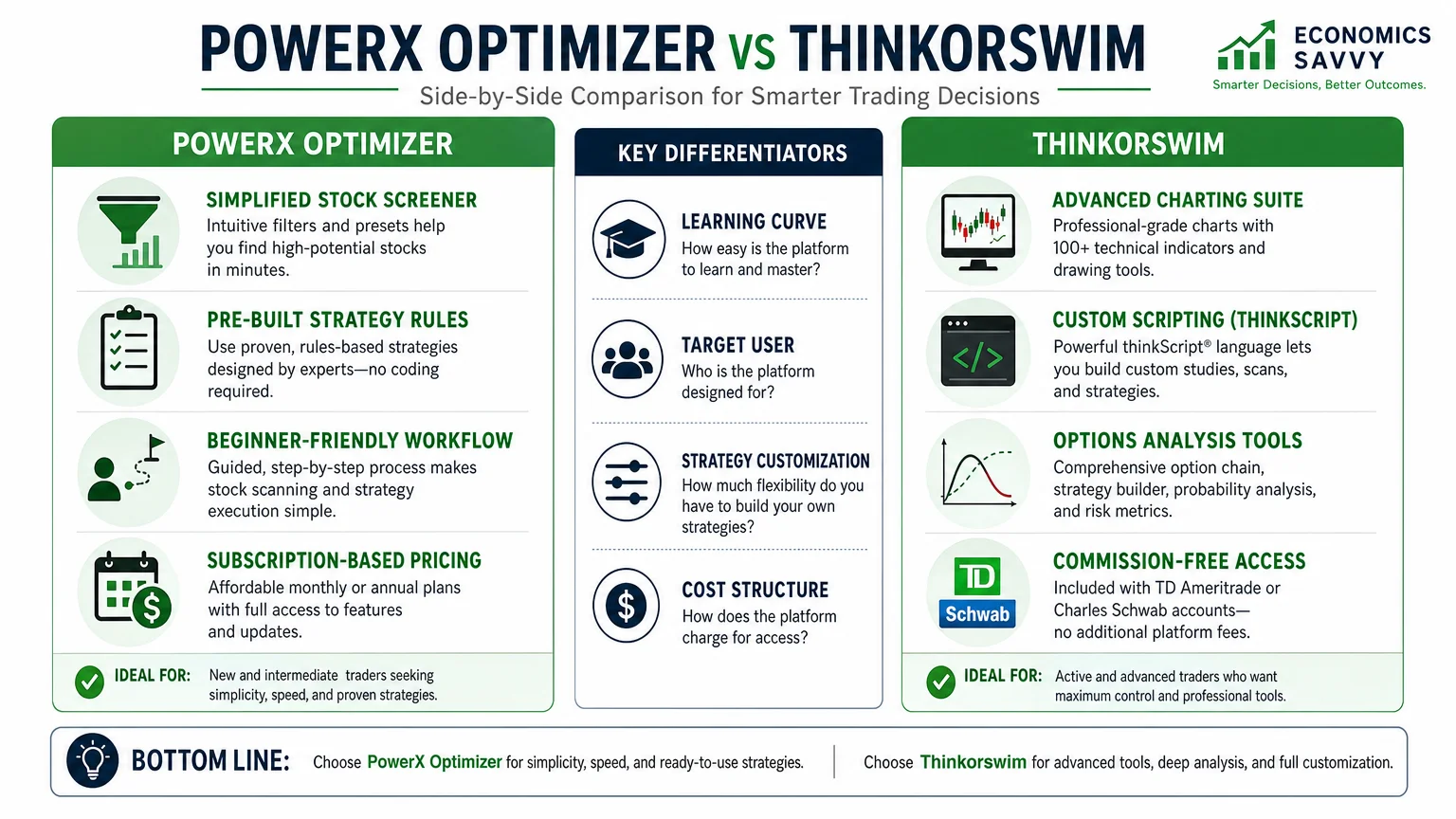
| Feature | PowerX Optimizer | Thinkorswim |
|---|---|---|
| Primary Purpose | Rule-based stock/options screener | Full-service brokerage trading platform |
| Target User | Systematic traders, beginners to intermediate | Intermediate to advanced traders |
| Learning Curve | Moderate — guided by strategy rules | Steep — highly customizable but complex |
| Cost | Subscription required | Free with Schwab brokerage account |
| Strategy Framework | Built-in (PowerX Strategy) | None — user defines their own |
| Options Analysis | Basic — focused on covered calls and puts | Advanced — multi-leg strategies, Greeks, probability tools |
| Custom Scripting | Not available | Yes (thinkScript) |
| Trade Execution | No — connects to a separate broker | Yes — direct execution within the platform |
| Educational Support | Integrated with Rockwell Trading resources | Schwab-provided tutorials and webcasts |
One practical note: PowerX Optimizer does not execute trades directly. Users still need a brokerage account — many pair it with Thinkorswim or a similar platform for execution. This means the comparison is sometimes less about choosing one over the other and more about understanding what role each plays in a trader’s workflow.
How Do the Costs Compare Between the Two Platforms?
Cost is a significant factor in this comparison, though the full picture is more nuanced than a simple price tag.
Thinkorswim is available at no additional cost to Schwab account holders. There are no subscription fees for the software itself, though standard brokerage commissions apply to options trades. For traders who already have or plan to open a Schwab account, Thinkorswim represents substantial analytical capability at no incremental software cost.
PowerX Optimizer requires a paid subscription. The exact pricing is available directly through Rockwell Trading, and it is worth verifying current rates before committing. The cost reflects not just the software but access to the strategic framework and associated educational materials that come with the Rockwell Trading ecosystem.
Whether that cost is justified depends on whether the structured approach genuinely changes how a trader operates. A powerful free platform that a trader uses inconsistently may deliver less practical value than a paid tool that instills a repeatable process. That said, cost is real, and traders on tight budgets should weigh it carefully. For a broader look at how trading tools are evaluated, the Product Reviews section offers additional context.
Which Platform Is Better for Options Trading Education?
For traders specifically looking to build options trading knowledge, the two platforms take different approaches. Thinkorswim provides access to Schwab’s educational library, webcasts, and paper trading — a simulated environment where traders can practice without real capital at risk. The paper trading feature is particularly valuable for learning how options behave across different market conditions.
PowerX Optimizer, through Rockwell Trading, integrates options education more directly into the trading strategy itself. The platform is designed around specific options plays — primarily covered calls and buying puts or calls in alignment with the PowerX Strategy — so the education and the tool are tightly coupled. Traders learn the strategy by using the software, rather than studying options theory independently and then applying it.
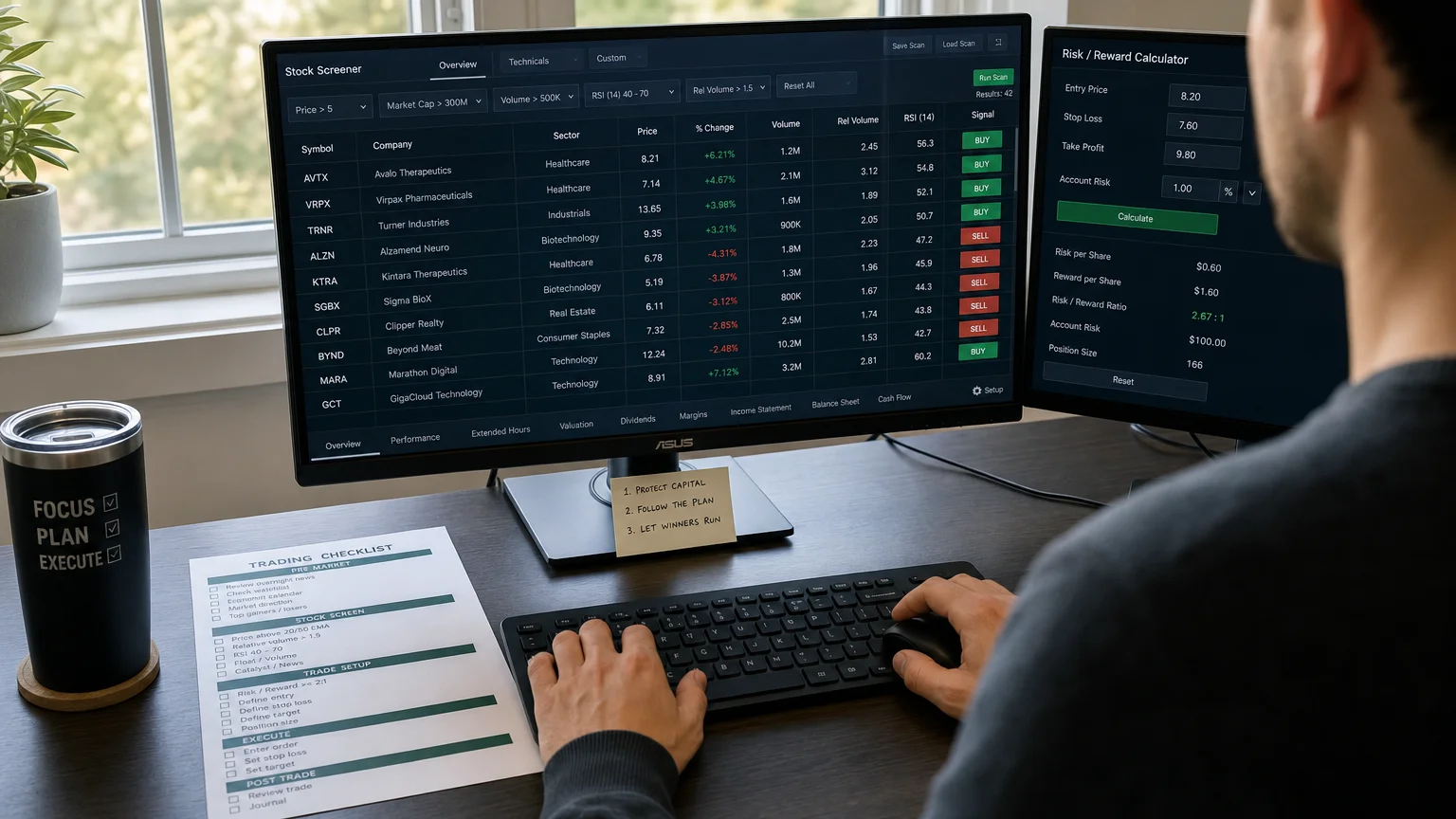
For traders who want to understand options broadly and build their own strategies, Thinkorswim’s environment is more flexible. For traders who want a specific, teachable method they can follow consistently, PowerX Optimizer’s integrated approach may be more effective. The Options Trading Education section of this site covers related concepts in more depth.
What Are the Key Risks Traders Should Understand Before Using Either Platform?
No trading platform eliminates the fundamental risks of trading stocks and options. Both PowerX Optimizer and Thinkorswim are tools — their quality does not change the underlying market dynamics that make trading genuinely difficult.
Options trading, in particular, carries the risk of losing the entire premium paid on a position. Strategies involving short options can carry theoretically unlimited risk if not managed properly. Systematic approaches like the PowerX Strategy reduce some behavioral risks (impulsive decisions, inconsistent entries) but do not remove market risk.
Traders should approach both platforms with a clear understanding of position sizing, maximum acceptable loss per trade, and overall portfolio risk. The Trading Risk section of this site addresses these concepts in practical terms and is worth reviewing before committing real capital to any strategy.
Conclusion
PowerX Optimizer and Thinkorswim address different problems for different traders. Thinkorswim offers exceptional breadth and professional-grade tools at no incremental software cost — but it requires the trader to bring their own strategy, discipline, and analytical framework. PowerX Optimizer provides that framework directly, at a subscription cost, for traders who want a defined process rather than an open canvas.
The right choice is not universal. It depends on where you are in your trading development, what kind of structure you need, and how much time you can realistically invest in learning a platform’s capabilities. For traders evaluating the broader landscape of trading software, understanding what problem each tool solves is the most useful starting point.
To explore more comparisons and practical breakdowns of trading tools and education, browse the related articles on Economics Savvy — or visit the About page to understand how this site approaches independent, transparent reviews.
Risk Disclosure: Trading stocks and options involves substantial risk of loss and is not suitable for all investors. Nothing on this site constitutes personalized investment advice. Economics Savvy is an independent affiliate site and may earn a commission on purchases made through clearly labeled links, at no additional cost to you.
Frequently Asked Questions
Can I use PowerX Optimizer and Thinkorswim together?
Yes. Many traders use PowerX Optimizer to identify and screen trade candidates, then execute those trades through Thinkorswim or another brokerage platform. The two tools serve different functions and are not mutually exclusive.
Does PowerX Optimizer work with Thinkorswim for trade execution?
PowerX Optimizer does not execute trades directly. It is a screening and strategy tool. Traders connect separately to a broker of their choice — Thinkorswim via Schwab is a common pairing, though it is not the only option.
Is Thinkorswim free to use in 2026?
Thinkorswim is available at no additional software cost to Charles Schwab account holders. Standard brokerage commissions still apply to trades, particularly options.
Who is PowerX Optimizer designed for?
PowerX Optimizer is built for traders who want a structured, rule-based approach to selecting stocks and options trades. It is particularly suited to those who prefer a defined strategy over open-ended analysis, and who are willing to follow a specific methodology consistently.
Does using either platform guarantee trading profits?
No. Neither platform guarantees any trading outcome. Trading stocks and options involves substantial risk of loss, and results vary widely based on market conditions, individual discipline, and risk management. No software can eliminate that risk.
What is the PowerX Strategy?
The PowerX Strategy is a rule-based trading methodology developed by Rockwell Trading. It uses specific technical indicators to identify trade candidates and provides defined entry, stop-loss, and profit-target levels. PowerX Optimizer is the software tool built around this strategy.
Is Thinkorswim suitable for beginners?
Thinkorswim is a powerful platform, but its depth and complexity can be overwhelming for beginners. It is generally better suited to traders who already have foundational knowledge and want more sophisticated tools. Beginners may benefit from starting with a more structured approach before moving to an open-ended platform.
Economics Savvy provides independent, risk-aware reviews of trading software and education based on daily use. Affiliate links are clearly disclosed; content is educational, not investment advice.