

Richard independently publishes Economics Savvy and has owned and used PowerX Optimizer since 2020. He shares first-hand observations about its workflow, features, limitations, and trading risk.
PowerX Optimizer is a trading software platform developed by Rockwell Trading, and pricing is consistently one of the first questions prospective buyers ask. This article provides a verified breakdown of what is publicly known about how much PowerX Optimizer costs, what that price covers, and what additional expenses buyers should anticipate before committing.
Trading Risk Disclosure: Trading stocks and options involves substantial risk of loss and is not suitable for all investors. Nothing in this article constitutes personalized investment advice. Economics Savvy may earn a commission if you purchase through clearly labeled affiliate links on this site, at no additional cost to you.
Key Takeaways
- PowerX Optimizer is sold by Rockwell Trading as a one-time license purchase rather than a recurring monthly subscription.
- The listed price has varied over time; always verify the current figure directly on the Rockwell Trading website before purchasing.
- The software license covers the scanner, signal generation, and strategy rules — not a brokerage account or data feed.
- Buyers should budget for a separate brokerage account and potentially a live data subscription depending on their setup.
- The software is designed for stocks and options trading using a specific rule-based strategy called the PowerX Strategy.
- A free trial or demo period may be available; confirm current availability with Rockwell Trading directly.
- Cost alone is not a sufficient evaluation criterion — fit with your trading style and risk tolerance matters equally.
- Economics Savvy does not guarantee any pricing figures; always confirm with the vendor.
What Is PowerX Optimizer and Who Makes It?
PowerX Optimizer is a desktop-based trading software tool built around a defined strategy for scanning and evaluating stocks and options candidates. Rockwell Trading, the company behind it, was founded by Markus Heitkoetter, who has published books and courses on rule-based trading approaches.
The software is not a brokerage platform. It does not execute trades on your behalf. Instead, it provides a structured workflow: scan a universe of stocks, apply the PowerX Strategy criteria, review the resulting candidates, and then place trades manually through a separate brokerage account. Understanding this distinction is important when evaluating whether the cost makes sense for your situation.
For a detailed look at what the platform actually does day-to-day, the article PowerX Optimizer Explained: What the Software Actually Does covers the workflow and feature set in practical terms.
How Much Does PowerX Optimizer Cost? The Verified Pricing Structure
The most direct answer available as of 2026 is that PowerX Optimizer is priced as a one-time license fee rather than a monthly subscription. The exact dollar amount is not reproduced here because pricing can change, and publishing a specific figure that later becomes outdated would mislead readers. The authoritative source for current pricing is the official Rockwell Trading website.
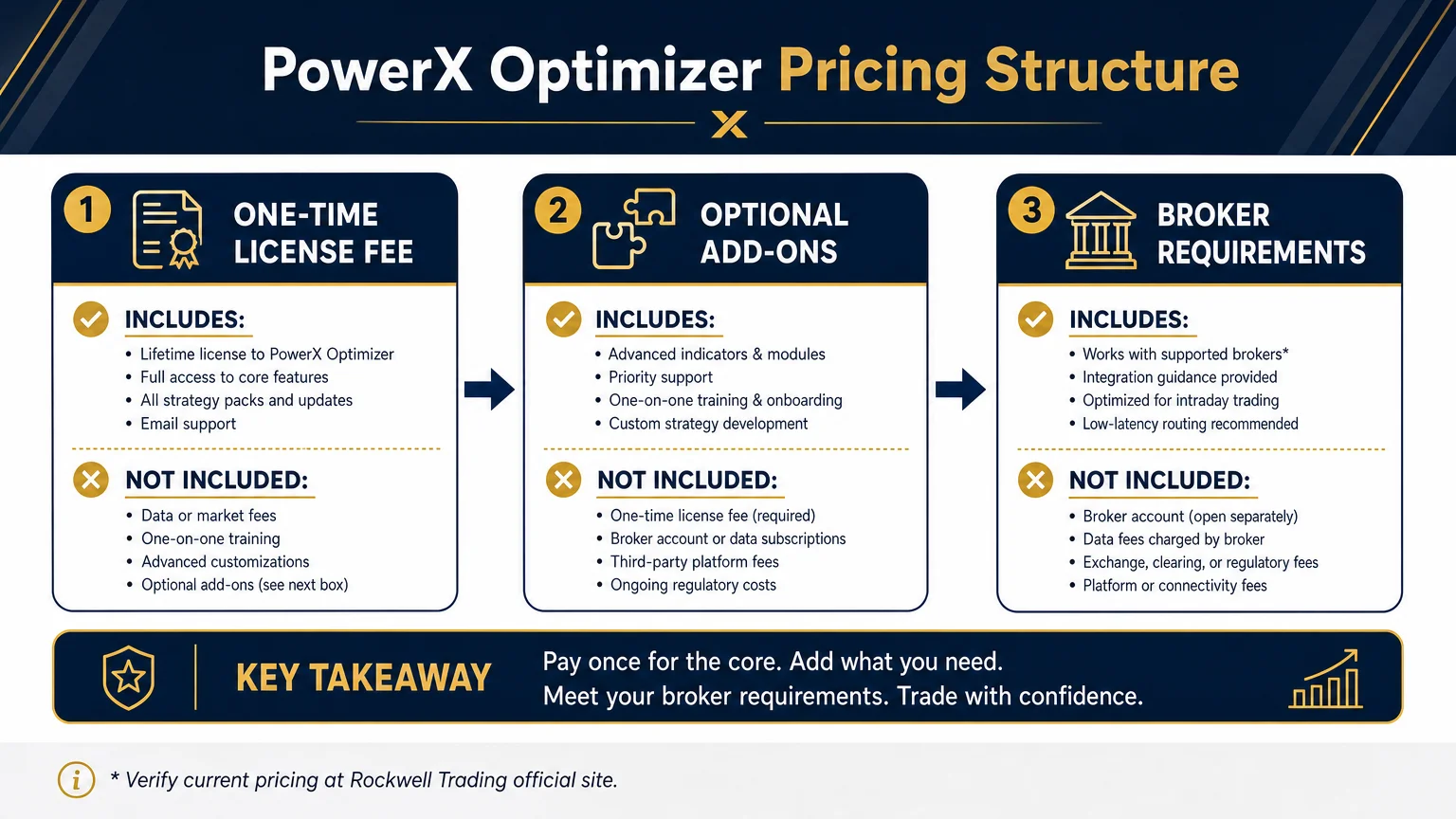
What is consistently reported across independent reviews and the vendor’s own materials is the one-time payment model, which distinguishes PowerX Optimizer from many competing platforms that charge monthly or annually. Over a multi-year period, a one-time license can represent a lower total cost than a subscription-based tool — but that calculation depends entirely on how long you use the software and whether you find it genuinely useful.
What the license fee typically covers:
- Access to the PowerX Optimizer desktop application
- The built-in stock and options scanner
- The PowerX Strategy signal logic
- Software updates for the licensed version (confirm scope with Rockwell Trading)
- Access to training materials included at the time of purchase
What the license fee does NOT cover:
- A brokerage account (required separately)
- Live market data feeds (may be included via your broker or require a separate subscription)
- Ongoing coaching or community access beyond what is bundled at purchase
- Any guarantee of trading results
Are There Additional Costs Beyond the Software License?
Yes — and this is where many buyers underestimate their total outlay. The software license is only one component of the full cost picture.
Brokerage account: You need a funded brokerage account to place the trades the software identifies. Minimum account sizes vary by broker and by whether you intend to trade options (which typically requires options approval and a minimum balance). Tastyworks, TD Ameritrade’s thinkorswim platform, and similar brokers are commonly referenced alongside PowerX Optimizer, though the software is not exclusively tied to any single broker.
Market data: Some brokers provide real-time data as part of their platform at no additional charge; others charge separately. Confirm your broker’s data policy before assuming it is free.
Capital at risk: This is not a software cost, but it is a real financial commitment. The strategy requires a funded account, and all capital placed in trades is subject to loss.
Education add-ons: Rockwell Trading offers additional courses and coaching programs. These are separate products with their own pricing and are not required to use the software, but some buyers choose to purchase them alongside the license.
For a broader perspective on what to look for when evaluating trading software costs and features, Options Trading Software for Beginners: What to Look for offers a useful framework.
How Does the One-Time License Model Compare to Subscription Alternatives?
The one-time license structure is a meaningful differentiator in a market where monthly fees of $50–$300 or more are common for comparable scanning and signal tools.
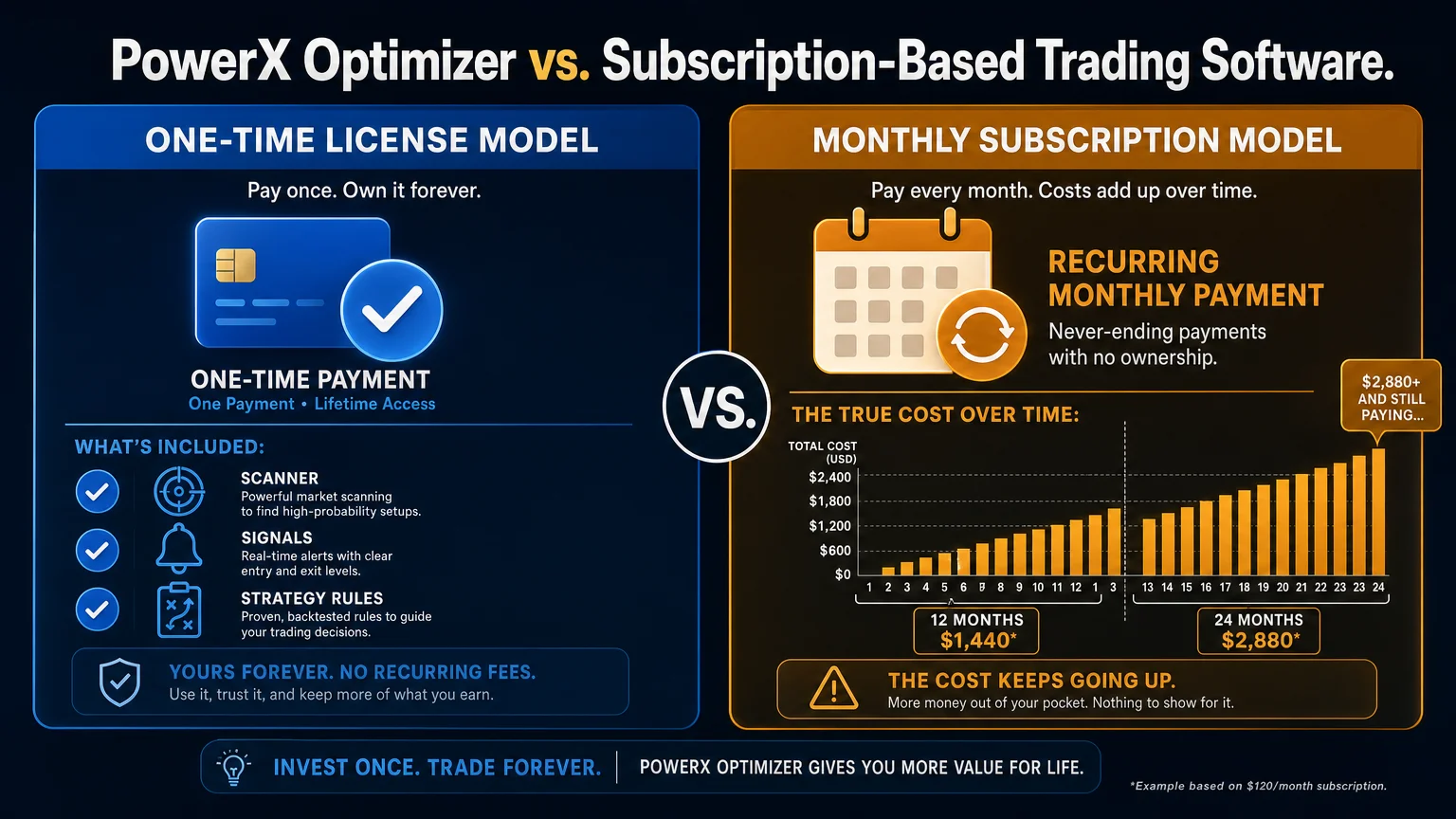
| Cost Model | Year 1 | Year 2 | Year 3 |
|---|---|---|---|
| One-time license (illustrative) | Higher upfront | $0 additional | $0 additional |
| Monthly subscription at $99/mo | $1,188 | $1,188 | $1,188 |
| Monthly subscription at $149/mo | $1,788 | $1,788 | $1,788 |
Note: The one-time license figure is intentionally left as “illustrative” because the actual price must be verified at the source. The subscription figures above are hypothetical comparisons only.
The break-even point — where the one-time license becomes cheaper than a monthly alternative — typically arrives within the first one to two years of use, depending on the specific prices involved. Buyers who are uncertain whether they will use the software long-term should weigh this carefully.
For a direct feature-by-feature comparison with a well-known free alternative, PowerX Optimizer vs. Thinkorswim: A Side-by-Side Look examines where each platform has an edge.
Is There a Free Trial or Money-Back Guarantee?
Rockwell Trading has offered trial periods and satisfaction guarantees at various points, but the specific terms — duration, conditions, refund eligibility — are subject to change. Do not rely on any third-party site, including this one, for the current trial or refund policy. Confirm directly with Rockwell Trading before purchasing.
When evaluating any trial offer, note what access is included during the trial period. A trial that limits the scanner or restricts live data may not give you a complete picture of the software’s day-to-day utility.
Is PowerX Optimizer Worth the Cost for Your Situation?
Cost-worthiness is not a universal answer — it depends on your trading experience, available capital, and whether the PowerX Strategy aligns with how you want to approach the market.
The software is built around a specific, rule-based strategy. If you are looking for a flexible multi-strategy platform, it may not be the right fit regardless of price. If you want a structured, opinionated workflow that removes some of the discretionary noise from stock selection, the defined approach may be exactly what you need.
One Month Using PowerX Optimizer Daily: Honest Observations documents practical observations from extended daily use — including workflow friction, what the scanner actually surfaces, and where the software’s limitations show up in real conditions.
Before any purchase decision, it is worth reading Stock and Options Trading Risk: What New Traders Must Know to ensure the broader risk picture is clearly understood. Software cost is a small variable compared to the capital at risk in live trading.
Conclusion
The core answer to how much PowerX Optimizer costs is straightforward in structure: a one-time license fee, with additional costs for a brokerage account and potentially a data feed. The specific dollar amount requires verification at the source, since pricing is subject to change and this article will not publish figures that may become outdated.
What matters beyond the headline price is whether the software fits your trading approach, your experience level, and your risk tolerance. A well-priced tool that does not match your workflow is not a good value; a higher-priced tool that genuinely improves your process may be entirely justified.
For the next step, review PowerX Optimizer Explained: What the Software Actually Does to understand the feature set before focusing on the price — knowing what you are buying is always the better starting point.
Frequently Asked Questions
What is the current price of PowerX Optimizer in 2026?
The exact current price must be verified directly on the Rockwell Trading website, as pricing can change. PowerX Optimizer is structured as a one-time license fee rather than a monthly subscription. No third-party source — including this article — should be treated as the authoritative price.
Does the PowerX Optimizer license include ongoing updates?
Software updates have historically been included for the licensed version, but the scope and duration of update coverage should be confirmed with Rockwell Trading at the time of purchase. Terms can change between product versions.
Do I need a specific broker to use PowerX Optimizer?
No single broker is required. The software generates trade candidates that you execute manually through your own brokerage account. You will need a broker that supports options trading if you intend to trade options, and you should confirm data feed compatibility.
Is there a monthly fee after the initial purchase?
The standard model is a one-time license with no recurring software fee. However, you may incur separate costs for live market data depending on your broker, and any add-on coaching or education products from Rockwell Trading are priced separately.
Can beginners justify the cost of PowerX Optimizer?
That depends on the individual. The software is designed to simplify stock and options candidate selection using a defined strategy, which some beginners find helpful. However, beginners should also ensure they understand options trading mechanics and risk management before committing capital — the software does not substitute for foundational education.
Is there a money-back guarantee?
Rockwell Trading has offered satisfaction guarantees in the past. Current terms, including duration and conditions, should be confirmed directly with the company before purchasing. Do not rely on third-party descriptions of guarantee terms.
How does PowerX Optimizer's pricing compare to free alternatives like thinkorswim?
Thinkorswim is a brokerage-integrated platform available at no direct software cost, while PowerX Optimizer carries an upfront license fee. The comparison is not purely about price — the two tools have different purposes, interfaces, and strategy frameworks. PowerX Optimizer vs. Thinkorswim: A Side-by-Side Look examines those differences in detail.
Where can I find the Financial Fortress audiobook mentioned on this site?
The Financial Fortress audiobook is a separate Rockwell Trading product focused on personal finance and trading mindset. [Financial Fortress Audiobook: What It Covers and Who It's For](/blog/financial-fortress-audiobook-what-it-covers-and-who-it-s-for/) explains its content and intended audience.
Richard independently publishes Economics Savvy and has owned and used PowerX Optimizer since 2020. He shares first-hand observations about its workflow, features, limitations, and trading risk.