

Richard is the independent publisher of Economics Savvy and has owned and used PowerX Optimizer since 2020. He shares first-hand observations about its workflow, features, limitations, and trading risk.
Most trading software promises to simplify the markets. PowerX Optimizer takes a more specific approach: it is built around a defined strategy, not an open-ended toolkit. Understanding what the software actually does — and what it deliberately does not do — is the most useful starting point for anyone evaluating it seriously.
Quick Answer: PowerX Optimizer is a stock and options screening tool developed by Rockwell Trading. It scans a universe of stocks and ETFs, scores them using a proprietary ranking system, and presents a short list of candidates that align with a specific trading strategy. It also displays charts with pre-configured indicators and includes an options profit calculator to help traders evaluate potential trades before entering them.
Key Takeaways
- PowerX Optimizer is not a general-purpose charting platform — it is purpose-built around one trading methodology.
- The software screens stocks and ETFs and ranks them using a proprietary scoring system called the PowerX Score.
- Charts come pre-loaded with three core indicators: RSI, MACD, and Money Flow.
- An integrated options calculator helps traders evaluate call and put setups without switching tools.
- The platform is designed for traders who want a structured, repeatable workflow rather than a fully customizable environment.
- It does not execute trades automatically — all decisions and order placement remain with the trader.
- The software is a product of Rockwell Trading, founded by Markus Heitkoetter.
- Suitability depends on individual goals, risk tolerance, and trading experience — no software eliminates trading risk.
What Problem Is PowerX Optimizer Designed to Solve?
The core problem PowerX Optimizer addresses is decision overload. With thousands of tradable stocks and ETFs available on U.S. exchanges, most retail traders spend more time searching for candidates than actually analyzing them. The software narrows that universe to a manageable shortlist each day, filtered through a consistent set of criteria.
Rather than asking traders to build their own screening rules from scratch, PowerX Optimizer applies a pre-built methodology and surfaces the tickers that meet it. The intended result is a faster, more consistent daily workflow — traders review a short list, check the chart, evaluate an options setup, and decide whether to act.
How Does the Screening and Ranking System Work?
The software scans stocks and ETFs and assigns each a PowerX Score, a proprietary ranking that reflects how well a given instrument aligns with the platform’s underlying strategy. Higher-scoring tickers appear at the top of the list; lower-scoring ones are filtered out or ranked lower.
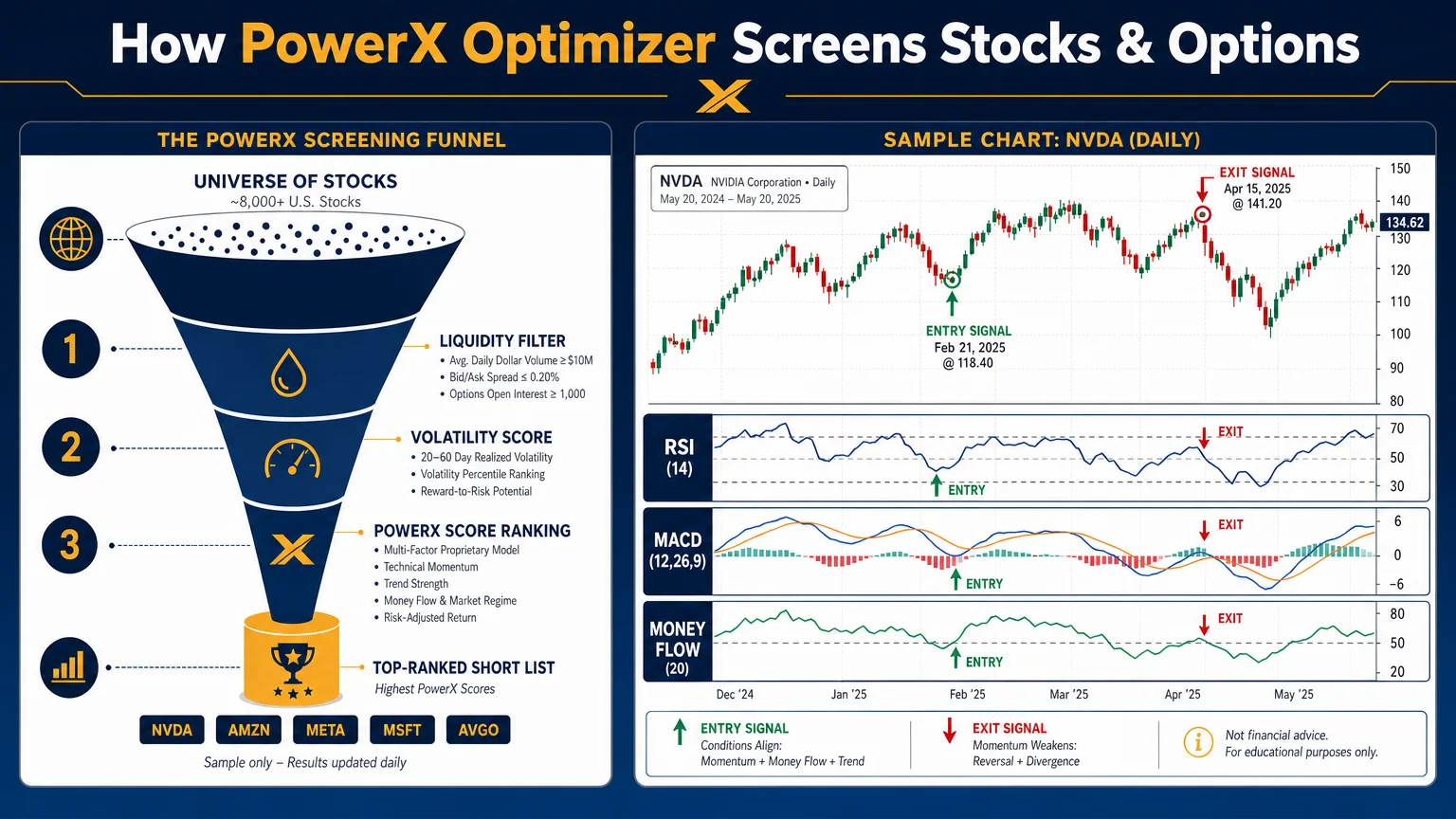
The exact weighting behind the PowerX Score is proprietary, but the strategy it reflects is publicly documented by Rockwell Trading. It incorporates momentum and trend-following logic, with the goal of identifying instruments that are moving with enough consistency and volatility to make defined-risk options trades viable. Liquidity is also a factor — thinly traded stocks with wide bid-ask spreads are generally not useful candidates for the strategy the software supports.
What Do the Charts and Indicators Actually Show?
Each ticker in the ranked list links to a chart view pre-loaded with three indicators: the Relative Strength Index (RSI), Moving Average Convergence Divergence (MACD), and Money Flow. These three indicators are the core of the “PowerX Strategy” taught by Rockwell Trading, and the software is explicitly built to support that strategy rather than to accommodate every possible technical approach.
This is a meaningful design choice. Traders who rely on Bollinger Bands, Fibonacci retracements, volume profile, or other tools will not find them built into the standard workflow. The platform is not trying to compete with fully customizable charting environments. For a direct comparison of how this differs from a general-purpose platform, the PowerX Optimizer vs. thinkorswim side-by-side look covers that contrast in practical detail.
The charts display buy and sell signals generated when the three indicators align according to the strategy’s rules. These signals are visual guides, not automated trade instructions — the trader interprets them and decides whether to act.
What Does the Options Calculator Do?
One of the more practically useful features of PowerX Optimizer is its integrated options profit calculator. When a trader identifies a potential stock candidate, they can use the calculator to model a call or put options trade — entering parameters like strike price, expiration date, and expected move — and see a projected profit/loss scenario before placing any order.
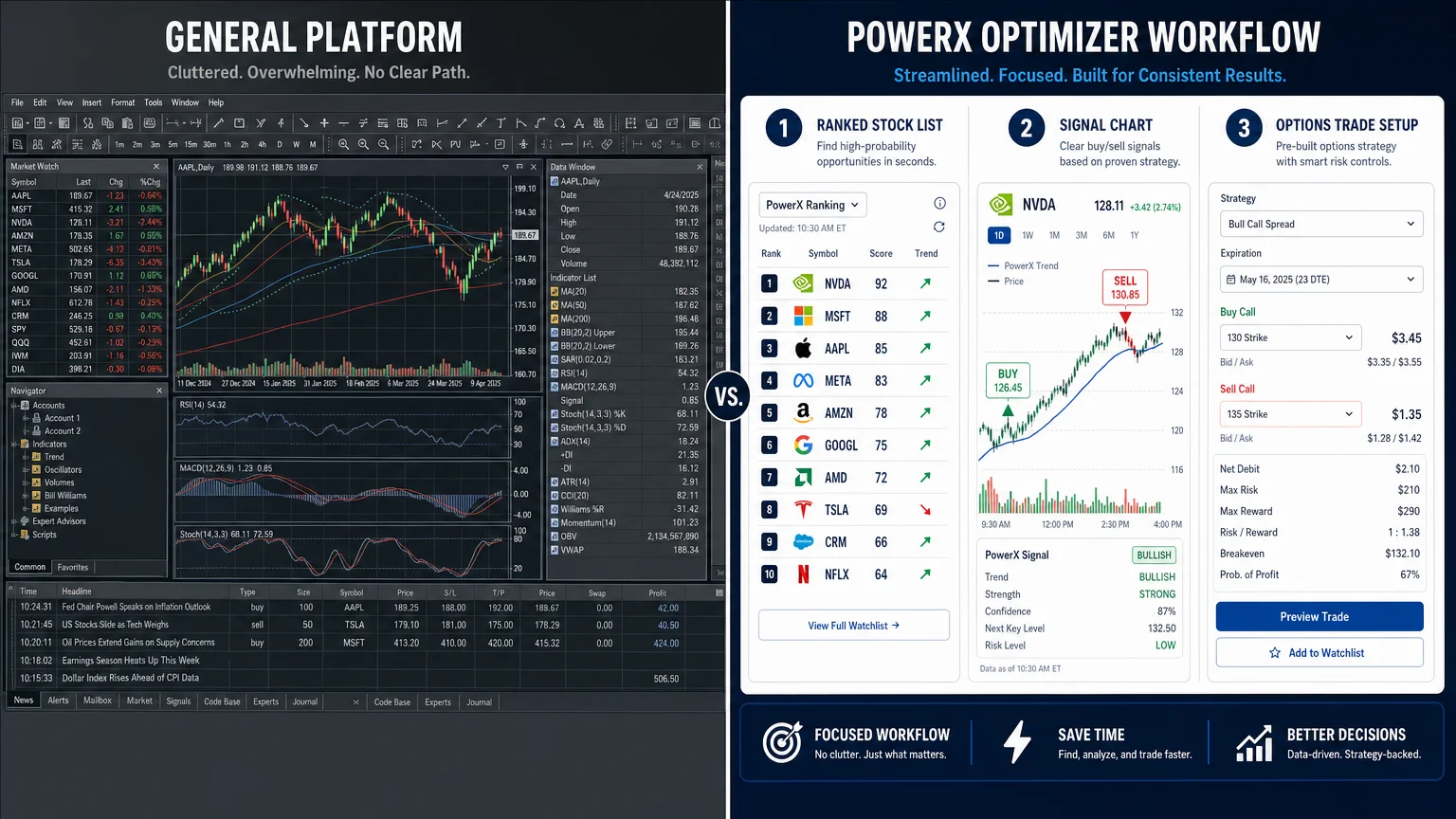
This removes the need to switch between the screening tool and a separate options modeling application. For traders newer to options mechanics, having the calculator embedded in the same workflow reduces friction and the risk of calculation errors. That said, options trading carries substantial risk, and projected scenarios in any calculator are estimates based on inputs — they are not guarantees of outcome. Anyone evaluating options tools for the first time should review the foundational concepts covered in options trading software for beginners: what to look for.
Is PowerX Optimizer Automated or Manual?
PowerX Optimizer does not place trades. It does not connect to a brokerage account to execute orders, and it does not operate as an algorithmic trading system. Every trade decision — entry, exit, position size, timing — remains entirely with the trader.
This distinction matters for two reasons. First, it means the software’s output is informational, not instructional. A high PowerX Score does not mean a trade is recommended; it means the instrument meets the criteria the strategy uses to identify candidates. Second, it means the trader bears full responsibility for every position taken. The software organizes and filters information; it does not manage risk on the trader’s behalf.
For a practical account of how this plays out in daily use, one month using PowerX Optimizer daily: honest observations documents real workflow patterns without performance claims.
Who Is This Software Built For?
PowerX Optimizer is most coherent as a tool for traders who have already decided — or are willing to commit — to the specific strategy Rockwell Trading teaches. It is not a neutral research environment. The screening logic, the indicators, the calculator, and the workflow are all designed around one approach to trading stocks and options.
Traders who want to run their own custom screens, apply different indicator sets, or use the platform as a general-purpose research hub will find it limiting. Traders who want a structured, repeatable daily process aligned to a defined methodology will find it efficient.
The platform is not marketed as suitable for day trading in the traditional sense. The strategy it supports is generally oriented toward swing trading — holding positions for days to weeks rather than minutes to hours. Traders with very short time horizons or those seeking high-frequency tools should evaluate whether the workflow matches their approach.
For context on the broader educational ecosystem around the software, Rockwell Trading’s Financial Fortress audiobook covers the foundational financial concepts that inform the methodology.
What Are the Practical Limitations Worth Knowing?
| Limitation | What It Means in Practice |
|---|---|
| Strategy-specific design | Cannot easily support other trading methodologies |
| No brokerage integration | Trades must be placed manually in a separate platform |
| No automated execution | Requires daily active review and decision-making |
| Limited indicator customization | Pre-configured for three core indicators |
| Screening universe | Focused on U.S. stocks and ETFs; not a global scanner |
| No performance guarantee | Past signal patterns do not predict future results |
Understanding these constraints before purchasing is more useful than discovering them afterward. For verified pricing information, how much does PowerX Optimizer cost provides a current breakdown without speculation.
What About Trading Risk?
No screening tool, indicator set, or ranking system removes the fundamental risk of trading. Markets move in ways that no software can reliably predict, and a trade that meets every criterion of a given strategy can still result in a loss. Position sizing, stop-loss discipline, and an honest assessment of personal risk tolerance are not features any software can substitute for.
Anyone considering PowerX Optimizer — or any trading tool — should read stock and options trading risk: what new traders must know before making decisions. Trading stocks and options involves substantial risk of loss and may not be suitable for all investors.
Conclusion
PowerX Optimizer is a focused, strategy-specific tool. It screens stocks and ETFs, ranks them by alignment with a defined methodology, presents pre-configured charts with three core indicators, and includes an options calculator — all within a single workflow. What it does not do is equally important: it does not trade automatically, does not replace risk management, and does not adapt to trading approaches outside its built-in strategy.
For traders evaluating whether the software fits their workflow, the most useful next step is understanding the strategy it supports before assessing the tool itself. Trading software in a volatile market: does workflow change? offers additional perspective on how structured tools perform under different market conditions.
Economics Savvy may earn a commission if you purchase through links on this page, at no additional cost to you. This article does not constitute investment advice. Trading stocks and options involves substantial risk of loss.
Frequently Asked Questions
Does PowerX Optimizer work with any brokerage?
PowerX Optimizer is a standalone screening and analysis tool. It does not integrate directly with brokerage accounts and does not place trades. Traders use it to identify and evaluate candidates, then execute orders through their own brokerage platform separately.
Can the software be used for day trading?
The strategy PowerX Optimizer is built around is generally oriented toward swing trading — positions held for days to weeks. It is not designed as a day trading or scalping tool, and the workflow does not support very short-term, intraday decision-making in the way a dedicated day trading platform would.
Does a high PowerX Score mean a trade is a good idea?
No. A high PowerX Score means a stock or ETF meets the criteria the platform's strategy uses to identify candidates. It is a filtering signal, not a trade recommendation. All decisions remain with the trader, and no score eliminates the risk of loss.
Is PowerX Optimizer the same as thinkorswim or other charting platforms?
No. PowerX Optimizer is purpose-built for one specific trading methodology. General-purpose platforms like thinkorswim offer broader customization, more indicators, and brokerage integration. The two tools serve different functions and are not direct substitutes.
Who makes PowerX Optimizer?
PowerX Optimizer is developed and sold by Rockwell Trading, a trading education company founded by Markus Heitkoetter. Economics Savvy is an independent affiliate site and is not affiliated with or operated by Rockwell Trading.
Does the software guarantee profits or specific results?
No. PowerX Optimizer does not guarantee any trading results, win rates, or profits. Trading involves substantial risk of loss, and no software can predict market outcomes. Any claims of specific results should be evaluated with significant skepticism.
Is PowerX Optimizer suitable for complete beginners?
The software assumes some familiarity with basic trading concepts — candlestick charts, options terminology, and order types. Complete beginners may benefit from working through foundational education before relying on the platform's workflow. Rockwell Trading offers educational resources alongside the software.
Richard is the independent publisher of Economics Savvy and has owned and used PowerX Optimizer since 2020. He shares first-hand observations about its workflow, features, limitations, and trading risk.