

Richard independently publishes Economics Savvy and has owned and used PowerX Optimizer since 2020. He shares first-hand observations about its workflow, features, limitations, and trading risk.
Roughly 70% of individual options contracts expire worthless — a statistic that underscores just how unforgiving this market can be for unprepared traders. Options trading risk is not a footnote; it is the central fact of the discipline. Understanding it before placing capital at risk is not optional.
This article covers the 7 core risk concepts that every beginner must understand before trading options in 2026. Whether you are exploring options for the first time or trying to build a more disciplined framework, these ideas form the foundation of every sound options strategy.
Key Takeaways
- Options can expire worthless, meaning the entire premium paid is lost.
- Sellers of uncovered options face theoretically unlimited downside.
- The Greeks — Delta, Theta, Vega, and Gamma — quantify different dimensions of risk.
- Implied volatility directly affects option pricing and can move against you even when price direction is correct.
- Position sizing is the most underrated risk control tool available to retail traders.
- Liquidity risk is often ignored by beginners but can trap capital in losing positions.
- A structured risk management process — not luck — separates sustainable traders from those who blow up accounts.
What Makes Options Trading Riskier Than Buying Stocks?
Options are leveraged instruments, meaning a small move in the underlying asset produces an amplified gain or loss on the option itself. A trader who buys 100 shares of a $50 stock risks $5,000. A trader who buys a call option on that same stock might control the same 100 shares for $350 in premium — but that $350 can go to zero completely, and it can do so in days.
The asymmetry cuts both ways. Buyers of options have defined maximum loss (the premium paid) but can still lose 100% of their invested capital. Sellers of options collect premium upfront but can face losses that dwarf what they received — particularly with uncovered or “naked” positions.
For a broader grounding in how these risks compare to standard equity trading, the article on stock and options trading risk: what new traders must know provides useful context before going deeper into options-specific mechanics.
Concept 1 — Maximum Loss Is Not Always What You Think
The most dangerous misconception in options trading is that “defined risk” means “small risk.” Yes, a long call or long put has a defined maximum loss equal to the premium paid. But that premium can represent a very large percentage of the trade’s value, and losing it entirely is a routine outcome — not a worst case.
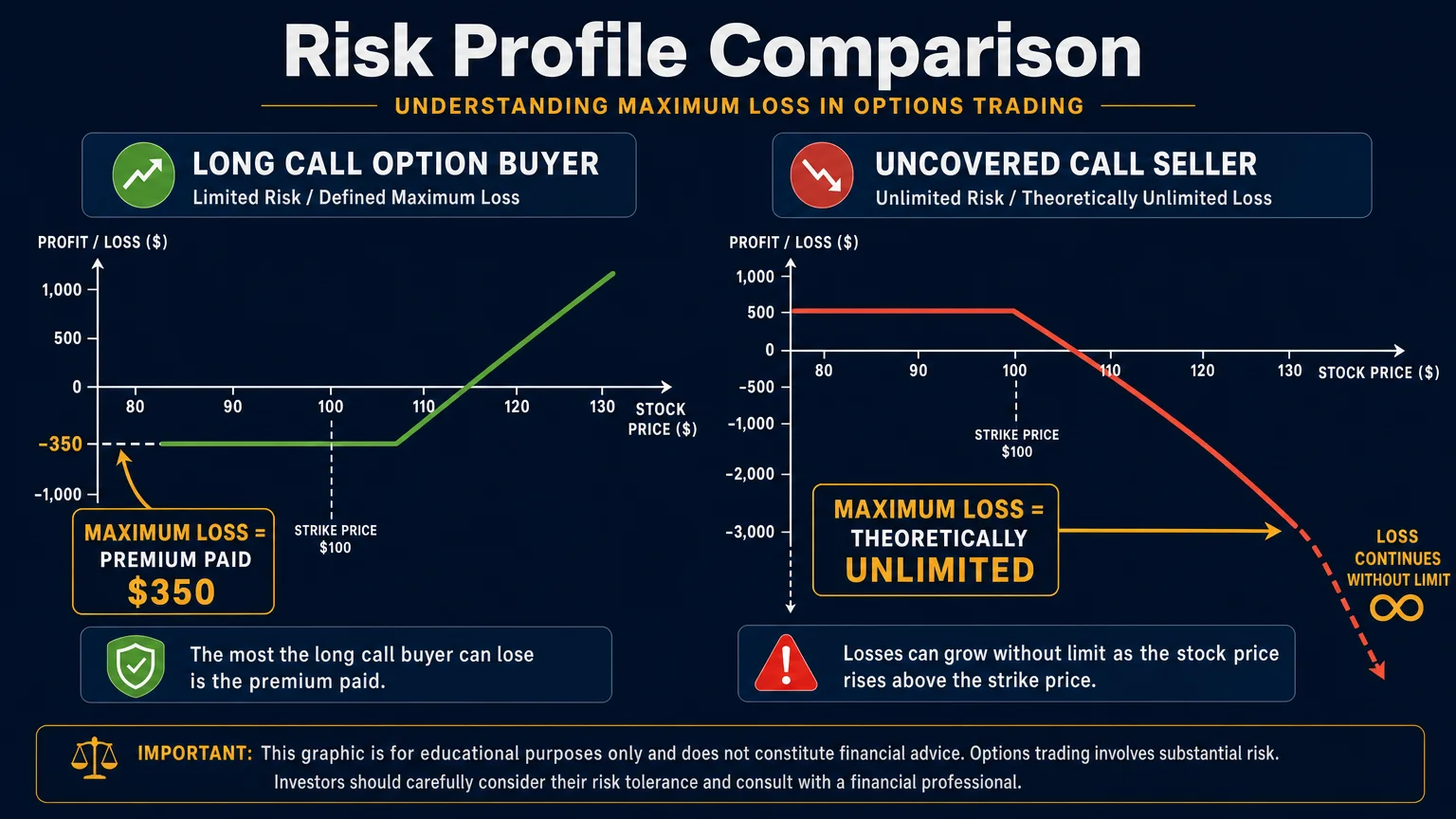
For options sellers, the risk picture is fundamentally different. A trader who sells a naked call on a stock trading at $100 and collects $2.00 in premium ($200 per contract) has a maximum gain of $200 — and a maximum loss that is theoretically unlimited if the stock surges. This asymmetry is why uncovered short positions require significant margin and why many brokers restrict them to experienced account holders.
Practical rule: Before entering any options position, calculate the exact dollar amount you stand to lose in the worst realistic scenario — not just the theoretical maximum.
Concept 2 — The Greeks Quantify Risk in Real Time
The “Greeks” are sensitivity measures that describe how an option’s price responds to changes in various market conditions. Beginners who ignore them are essentially flying blind.
| Greek | What It Measures | Why It Matters |
|---|---|---|
| Delta | Price sensitivity to the underlying asset | Tells you how much the option moves per $1 move in the stock |
| Theta | Time decay | Options lose value every day; Theta shows the daily cost |
| Vega | Sensitivity to implied volatility | A volatility collapse can destroy option value even if price moves correctly |
| Gamma | Rate of change of Delta | Accelerates risk near expiration; can cause rapid, unexpected losses |
Theta is particularly punishing for buyers. An at-the-money option with 30 days to expiration loses value every single day the underlying price stays flat. This time decay accelerates sharply in the final two weeks before expiration — a period that catches many beginners off guard.
Concept 3 — Implied Volatility Can Work Against You Even When You’re Right
Implied volatility (IV) is the market’s expectation of future price movement, embedded in the option’s price. When IV is high, options are expensive. When IV collapses — often after an earnings announcement or a resolution of market uncertainty — option prices fall sharply, regardless of what the underlying stock does.
This phenomenon, sometimes called a “volatility crush,” is one of the most common ways beginners lose money on options. A trader buys a call before earnings, the stock rises 3% as expected, but IV drops 40% post-announcement. The option loses value despite the correct directional call.
Understanding where implied volatility sits relative to its historical range — often expressed as IV Rank or IV Percentile — is essential before buying any option. Buying options when IV is already elevated dramatically reduces the probability of a profitable outcome.
Concept 4 — Liquidity Risk Can Trap You in Losing Positions
Options on thinly traded stocks or far out-of-the-money strikes often have wide bid-ask spreads. A spread of $0.50 on a $1.00 option means you are immediately down 50% the moment you enter the trade, before the market moves at all.
Liquidity risk also means that exiting a losing position quickly may be difficult or costly. In fast-moving markets, the bid-ask spread on illiquid options can widen dramatically, forcing traders to accept unfavorable prices or hold positions they would prefer to close.
Checklist for liquidity before entering an options trade:
- Open interest above 500 contracts (minimum)
- Daily volume above 100 contracts
- Bid-ask spread below 10% of the option’s mid-price
- Underlying stock with average daily volume above 500,000 shares
Concept 5 — Position Sizing Is the Most Underused Risk Tool
Most beginners focus on which trade to make. Experienced traders focus equally on how much to risk. Position sizing — the discipline of limiting the percentage of total account capital at risk on any single trade — is what keeps a losing streak from becoming a catastrophic account drawdown.
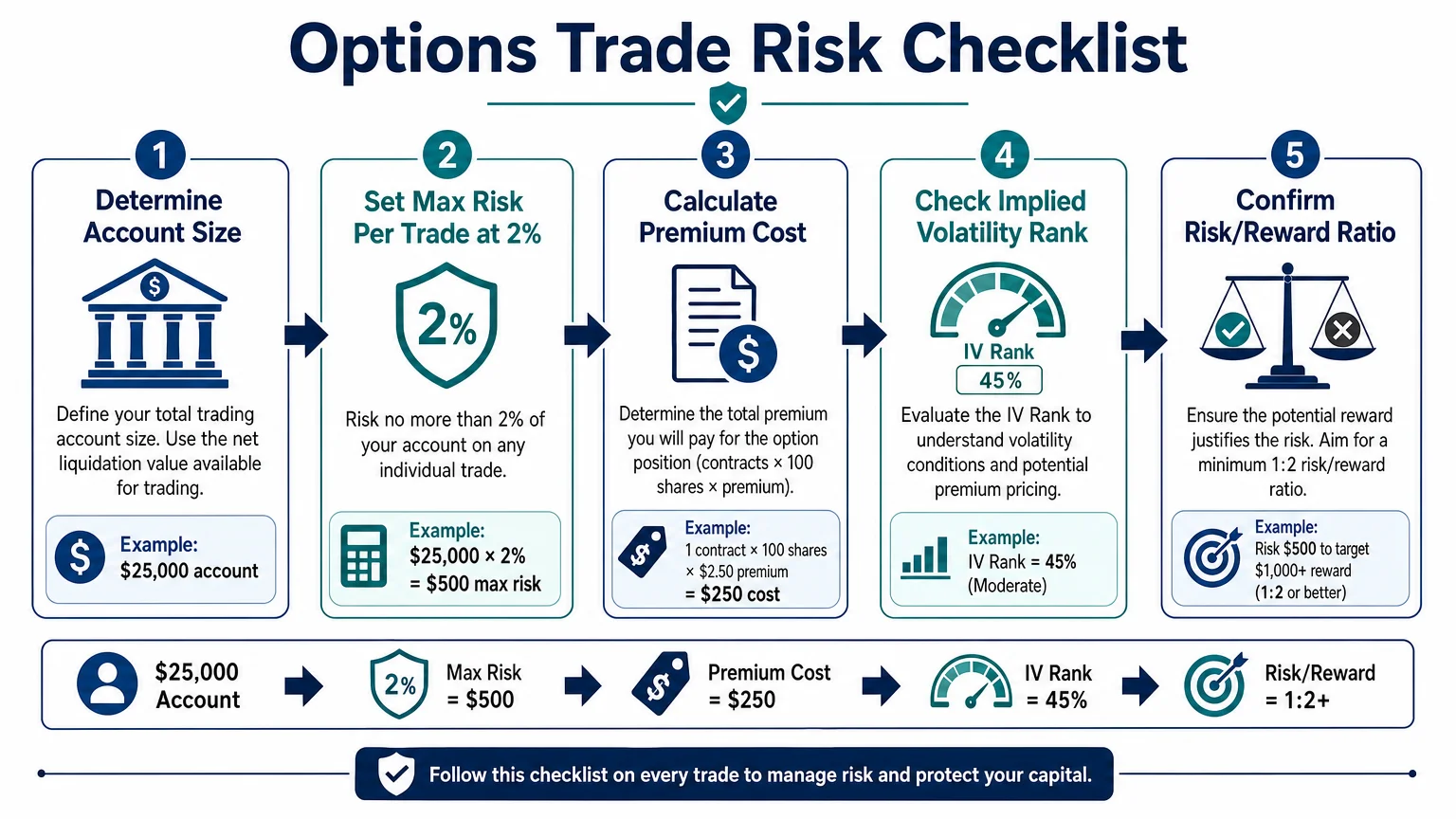
A common framework is to risk no more than 1–2% of total account capital on any single options trade. On a $25,000 account, that means a maximum loss of $250–$500 per trade. This constraint forces traders to select strikes and expirations that fit within a defined risk budget rather than simply buying whatever looks interesting.
Position sizing also interacts with the leverage inherent in options. Because options can lose 100% of their value, the position size must be calibrated to the premium paid — not the notional value of the underlying shares controlled.
Tools like PowerX Optimizer are designed in part to help traders identify setups that align with structured risk parameters, which is one reason systematic software has become popular among retail options traders who want a repeatable process rather than ad hoc decision-making.
Concept 6 — Expiration Date Risk Is a Hard Deadline
Unlike stocks, options have an expiration date. After that date, an out-of-the-money option is worth exactly zero. This creates a hard deadline that does not exist in equity investing — and it changes the psychology and mechanics of risk management entirely.
Traders who hold options too close to expiration face accelerating Theta decay and a dramatic increase in Gamma risk, meaning small price moves can cause outsized swings in option value. Many experienced traders close positions well before expiration — often at 50% of maximum profit or when a defined stop-loss level is reached — rather than holding to the final day.
The discipline of managing expiration risk is covered in depth in structured options education programs. For beginners looking to build that foundation systematically, the stock trading education resources on this site offer a useful starting point.
Concept 7 — Emotional Risk Is as Real as Market Risk
Behavioral risk — the tendency to hold losers too long, chase losses, or abandon a sound strategy after a string of bad trades — is documented extensively in trading psychology research. Options amplify this problem because of the speed at which positions can move and the finality of expiration.
A beginner who watches a $500 option position fall to $50 in two days faces a powerful psychological pull to hold on and “wait for a recovery.” In equities, that instinct occasionally works. In options, it frequently results in a 100% loss when expiration arrives.
Building a written trade plan before entering any position — specifying the entry rationale, the maximum loss accepted, and the exit criteria — is one of the most effective ways to reduce emotional decision-making. Resources like the Financial Fortress audiobook address the mindset and financial framework side of trading discipline, which complements the technical risk concepts covered here.
How Do Beginners Build a Practical Options Risk Management Process?
A repeatable process matters more than any single tactic. The following framework consolidates the seven concepts above into a pre-trade checklist:
- Define maximum loss in dollars before placing the trade.
- Check implied volatility rank — avoid buying options when IV is historically elevated.
- Verify liquidity using open interest, volume, and bid-ask spread.
- Size the position so maximum loss does not exceed 1–2% of account capital.
- Set a Theta-aware exit plan — know when you will close the trade regardless of outcome.
- Record the trade rationale in writing to reduce emotional interference.
- Review the Greeks at entry and monitor Delta and Vega exposure throughout the trade.
For traders evaluating software tools that can assist with steps 1–4, a detailed look at one month using PowerX Optimizer daily offers honest observations about how the tool fits into a structured workflow.
Conclusion
Options trading risk is multi-dimensional — it involves market direction, time, volatility, liquidity, leverage, and human psychology, all operating simultaneously. The seven concepts covered here — maximum loss, the Greeks, implied volatility, liquidity risk, position sizing, expiration risk, and emotional risk — are not advanced topics reserved for professionals. They are the baseline knowledge every beginner needs before committing real capital.
Understanding these concepts does not guarantee profitable trading. It does, however, dramatically reduce the probability of the kind of avoidable, catastrophic losses that end trading careers before they begin.
For a deeper look at how trading software can support a structured risk management process, explore the PowerX Optimizer review or browse the trading software section for additional resources.
Disclaimer: Trading stocks and options involves substantial risk of loss and is not suitable for every investor. Economics Savvy does not provide personalized investment advice and does not guarantee any trading outcomes. All content is for educational purposes only.
Frequently Asked Questions
What is the maximum loss on a long options trade?
The maximum loss on a long call or long put is limited to the premium paid for the contract. If you pay $300 for an option and it expires worthless, you lose $300 — no more. However, losing 100% of the premium is a common outcome, not a rare worst case.
Can you lose more than you invest in options trading?
If you buy options, no — your loss is capped at the premium paid. If you sell uncovered (naked) options, yes — losses can exceed the premium collected and, in the case of a naked call, are theoretically unlimited.
What does implied volatility have to do with options risk?
Implied volatility is priced into the option's premium. When IV is high, options are expensive, and a subsequent drop in IV (even without a move in the underlying stock) will reduce the option's value. This is called a volatility crush and is a frequent cause of losses for options buyers.
How important is position sizing for options traders?
Position sizing is one of the most critical risk controls available. Because options can lose 100% of their value, limiting each trade to 1–2% of total account capital ensures that no single loss — or even a series of losses — is catastrophic to the overall account.
What are the Greeks in options trading?
The Greeks are mathematical measures of an option's sensitivity to various factors: Delta measures sensitivity to the underlying price, Theta measures time decay, Vega measures sensitivity to implied volatility, and Gamma measures the rate of change of Delta. Together they give traders a quantified view of their risk exposure.
Why do most options expire worthless?
Most options expire worthless because the underlying asset does not move far enough in the right direction before expiration. The combination of time decay, transaction costs, and the difficulty of predicting both direction and timing means the majority of options purchased do not reach their strike price profitably.
Is options trading suitable for every investor?
No. Options trading involves substantial risk of loss, requires understanding of complex instruments, and may not be suitable for all investors. Anyone considering options trading should thoroughly understand the risks involved and consider whether the activity aligns with their financial situation and risk tolerance.
Richard independently publishes Economics Savvy and has owned and used PowerX Optimizer since 2020. He shares first-hand observations about its workflow, features, limitations, and trading risk.