

Economics Savvy provides independent, risk-aware reviews of trading software and education based on daily use. Affiliate links are clearly disclosed; content is educational, not investment advice.
Fewer than 20% of individual options traders consistently apply structured risk management, according to research cited by the Options Industry Council — a gap that education tools, whether books or software, are specifically designed to close. This comparison of options trading education tools examines two primary paths: self-study resources and dedicated trading software. Understanding the differences helps you choose an approach that matches your learning style, available time, and tolerance for trading risk.
Key Takeaways
- Self-study tools (books, courses, video libraries) offer low-cost, flexible learning but require strong self-discipline and provide no real-time feedback.
- Trading software platforms combine education with live market data, strategy scanners, and backtesting — compressing the learning curve significantly.
- Neither path eliminates risk; options trading involves substantial potential for loss regardless of the tools used.
- Hybrid approaches — pairing structured coursework with software practice — tend to produce more well-rounded traders.
- Cost structures differ considerably: self-study resources range from free to a few hundred dollars, while quality trading software typically carries a recurring subscription.
- The best tool is the one you will actually use consistently over time.
- Beginners benefit most from foundational self-study before committing to a software subscription.
- Experienced traders often gain more from software that surfaces opportunities they would otherwise miss manually.
What Exactly Are Options Trading Education Tools?
Options trading education tools are any resource — structured or unstructured — designed to help a trader understand how options contracts work, how to build and manage strategies, and how to assess risk. The category spans a wide spectrum: printed textbooks, PDF guides, video courses, webinar libraries, paper trading simulators, strategy scanners, and fully integrated trading software platforms. When comparing options trading education resources, the key variables are depth of content, interactivity, cost, and how closely the tool mirrors real market conditions.
How Does Self-Study Compare to Software-Based Learning?
Self-study and software-based learning are not mutually exclusive, but they serve different functions. Self-study builds conceptual foundations — understanding what a covered call is, how implied volatility affects pricing, or why theta decay accelerates near expiration. Software-based tools apply those concepts against live or historical data, giving traders immediate feedback on whether a strategy would have worked.
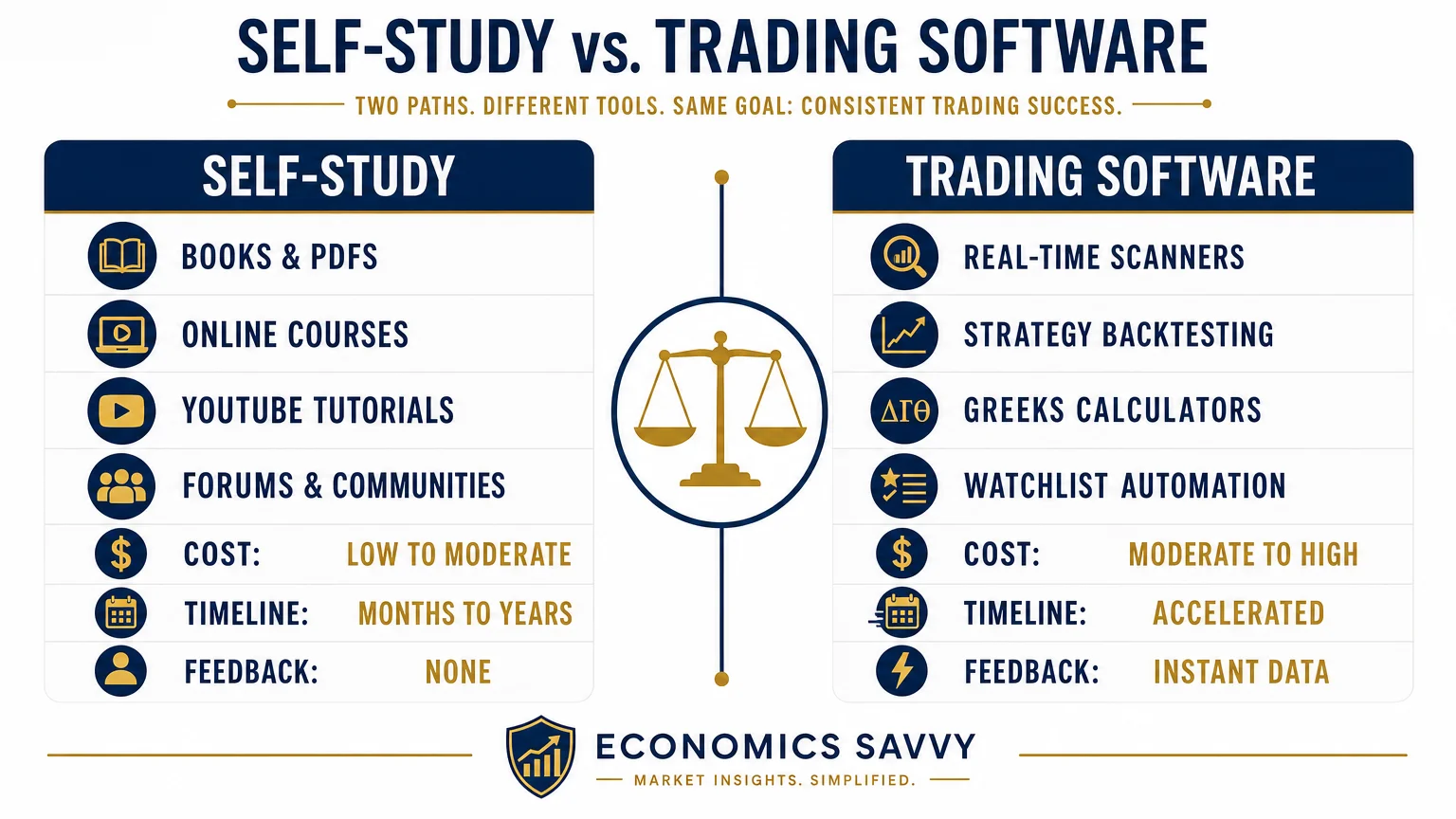
A useful way to frame the comparison is by what each approach does well and where it falls short:
| Dimension | Self-Study | Trading Software |
|---|---|---|
| Conceptual depth | High | Moderate to high |
| Real-time feedback | None | Immediate |
| Cost | Low to moderate | Moderate to high (subscription) |
| Pace of learning | Self-directed | Structured by platform |
| Risk of information overload | Low | Moderate |
| Practical application | Limited | Central feature |
| Backtesting capability | None | Often included |
| Community support | Variable | Often built in |
Neither column is clearly superior. A trader who completes a rigorous self-study curriculum but never practices in a live or simulated environment has theoretical knowledge without execution skill. Conversely, a trader who jumps straight into software without understanding the underlying mechanics may misread the signals the platform surfaces.
What Self-Study Options Trading Education Tools Are Worth Your Time?
The self-study category is broad, and quality varies considerably. The most reliable resources tend to be those with clear author credentials, a structured curriculum, and content that distinguishes between strategy mechanics and actual trading advice.
Books and written guides remain the most cost-efficient starting point. Titles focused on options fundamentals — covering calls, puts, spreads, and the Greeks — provide vocabulary and conceptual grounding that no software dashboard can fully replace. The challenge is that books go out of date as market structure evolves, and they cannot reflect current implied volatility environments.
Online video courses offer a middle ground: structured like a curriculum but more current than print. Reputable platforms curate instructor credentials and update content periodically. The risk is that many courses are produced by marketers rather than practitioners, so scrutinizing the instructor’s background before purchasing matters.
Webinar libraries and recorded sessions from established trading educators provide a sense of how professionals think through live setups — a dimension that static text cannot replicate. Rockwell Trading, the company behind PowerX Optimizer, maintains educational content that complements its software tools, which is worth noting for traders already evaluating that ecosystem.
For a broader overview of the stock trading education landscape, including what to look for in structured programs, that resource provides useful context alongside this comparison.
What Do Trading Software Platforms Offer That Self-Study Cannot?
Trading software platforms address the single biggest gap in self-study: the absence of real-world application. The most capable platforms combine several functions that would otherwise require separate tools.
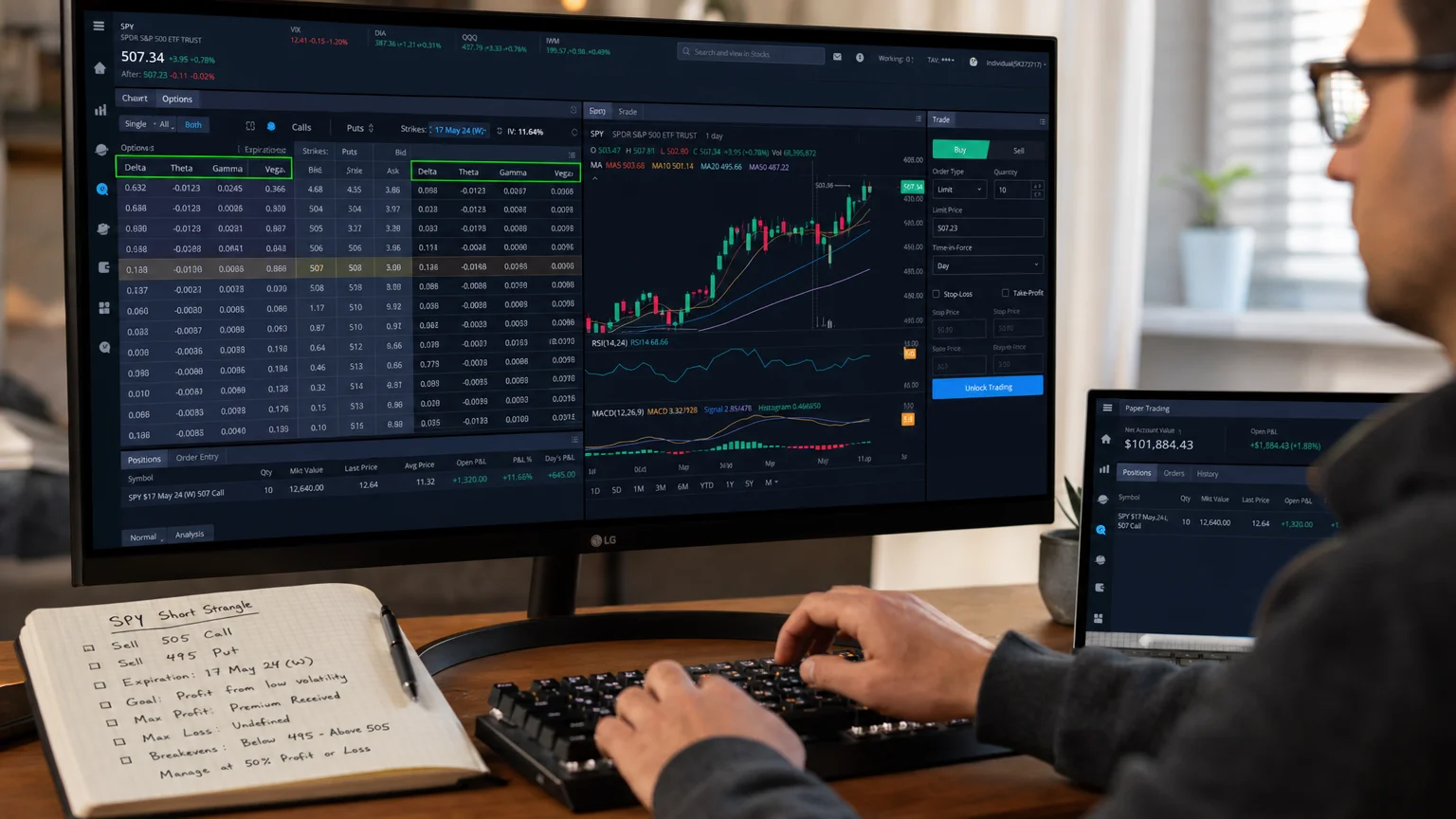
Strategy scanners filter the entire options market against user-defined criteria — specific delta ranges, minimum open interest, days to expiration — surfacing candidates that match a trader’s stated approach. Doing this manually from a self-study framework would take hours; software reduces it to seconds.
Backtesting engines allow traders to test how a strategy would have performed against historical price data before committing real capital. This is particularly valuable for options traders because the interaction between time decay, volatility, and price movement is difficult to intuit without repeated exposure to historical examples.
Greeks calculators and real-time P&L modeling show how a position’s risk profile changes as the underlying moves, time passes, or implied volatility shifts. Understanding these dynamics conceptually from a textbook is one thing; watching them move in real time on a live position is another.
PowerX Optimizer, reviewed in more detail in the PowerX Optimizer review: what it does and who it’s for, is an example of a platform that integrates scanning, signal generation, and educational context into a single workflow. It is designed specifically for busy traders who want a structured, repeatable process rather than an open-ended research environment.
For traders also evaluating brokerage-integrated platforms, the PowerX Optimizer vs. thinkorswim comparison outlines how a dedicated trading tool differs from a full-service brokerage platform — a distinction that matters when choosing where education and execution overlap.
What Are the Real Costs of Each Approach?
Cost comparisons between self-study and software require looking beyond the sticker price to include time investment, which has real economic value for working adults.
Self-study costs appear low on the surface — a book costs under $50, and many video courses are available for under $200. However, the time required to build a functional trading framework from scratch through self-study alone is measured in months, not weeks. For someone with limited trading hours per week, that timeline has an opportunity cost.
Trading software subscriptions typically run from several hundred to over a thousand dollars annually, depending on the platform and feature set. That cost is only justified if the trader uses the platform consistently and applies its outputs with discipline. Paying for software and not using it is a common and avoidable mistake.
A hybrid approach — completing a structured self-study curriculum first, then adopting software once the conceptual foundation is in place — tends to produce the best return on both time and money.
Who Should Prioritize Self-Study, and Who Should Go Straight to Software?
The honest answer depends on where a trader currently sits on the knowledge curve.
Prioritize self-study if:
- You are new to options and unfamiliar with basic contract mechanics
- You have significant free time and prefer learning at your own pace
- You want to minimize upfront costs while building foundational knowledge
- You are skeptical of software-generated signals and want to understand the underlying logic first
Consider software sooner if:
- You already understand options basics and want to apply them systematically
- Your available trading time is limited and you need a structured, repeatable process
- You want to backtest strategies before risking capital
- You are evaluating whether a specific platform’s methodology aligns with your trading style
For a deeper discussion of how software tools fit within a broader approach to trading software selection, that resource covers the evaluation criteria that apply across platforms.
What Risks Should Traders Understand Before Choosing Either Path?
No education tool — self-study or software — eliminates the fundamental risks of options trading. Options contracts can expire worthless, losses can exceed initial premiums in certain strategies, and market conditions can change faster than any educational framework can anticipate. This is not a reason to avoid education; it is a reason to approach it honestly.
The trading risk section of this site covers these dynamics in more detail, including how to think about position sizing and the difference between paper trading performance and live trading results.
A few specific risks worth naming in this context:
- Overconfidence from structured learning: Completing a course or mastering a software platform does not confer edge. Markets are competitive, and most retail traders face structural disadvantages relative to institutional participants.
- Confusing signal generation with strategy: Software that surfaces options candidates is a starting point, not a complete trading plan. Risk management, position sizing, and exit discipline are not automated by any platform.
- Recency bias in backtesting: Historical performance of a strategy does not guarantee future results, particularly in options where volatility regimes shift.
Conclusion
The comparison between self-study and software-based options trading education tools is not a binary choice — it is a sequencing question. Self-study builds the conceptual vocabulary that makes software outputs meaningful. Software accelerates the application of that knowledge against real market conditions. The most effective approach combines both, with the balance shifting toward software as foundational knowledge solidifies.
For traders ready to explore how a structured software platform fits into their education process, the PowerX Optimizer review offers a detailed look at one platform’s specific workflow, features, and intended audience. As always, any trading activity involves substantial risk of loss, and no educational tool changes that fundamental reality.
Economics Savvy may earn a commission on purchases made through links on this page. See our Affiliate Disclosure for details.
Frequently Asked Questions
Is self-study enough to trade options profitably?
Self-study can build the conceptual foundation needed to understand options mechanics, but it rarely provides sufficient practical experience on its own. Most traders benefit from combining structured learning with paper trading or software-based simulation before committing real capital. Profitability in options trading depends on consistent execution and risk management, not just theoretical knowledge.
What is the main advantage of trading software over books and courses?
Trading software applies concepts to real or historical market data in real time. It surfaces strategy candidates, models risk scenarios, and tracks position performance in ways that static educational materials cannot. The primary advantage is the compression of the feedback loop — traders see how ideas perform against actual market conditions rather than hypothetical examples.
How much does options trading education software typically cost?
Costs vary widely. Entry-level platforms may be available for a few hundred dollars annually, while more comprehensive tools with full scanning, backtesting, and signal generation can run higher. Prices change, so verifying current pricing directly with the provider before purchasing is always advisable.
Can beginners use trading software without prior options knowledge?
Most dedicated trading software assumes some baseline familiarity with options concepts. Beginners who jump straight into software without understanding the Greeks, basic strategy types, or contract mechanics often misinterpret the signals the platform generates. A short self-study phase before adopting software tends to produce better outcomes.
Does PowerX Optimizer include educational content?
PowerX Optimizer is primarily a scanning and signal tool rather than a standalone educational curriculum, but Rockwell Trading — the company behind it — provides supporting educational materials. Traders evaluating the platform should review what educational resources are included or available separately through Rockwell Trading's offerings.
Is paper trading a substitute for live trading experience?
Paper trading is a useful bridge between theoretical knowledge and live execution, but it does not fully replicate the psychological pressures of trading real capital. It is a valuable step, particularly for testing a new strategy or platform, but should not be treated as equivalent to live trading experience.
What is the biggest mistake traders make when choosing education tools?
The most common mistake is choosing a tool based on marketing rather than fit. A sophisticated software platform is not useful to a trader who lacks the foundational knowledge to interpret its outputs. Conversely, spending years in self-study without ever applying knowledge in a live or simulated environment delays practical development unnecessarily.
Economics Savvy provides independent, risk-aware reviews of trading software and education based on daily use. Affiliate links are clearly disclosed; content is educational, not investment advice.