

Richard independently publishes Economics Savvy and has owned and used PowerX Optimizer since 2020. He shares first-hand observations about its workflow, features, limitations, and trading risk.
After 30 consecutive trading days with PowerX Optimizer running as the primary stock and options screening tool, a clear picture emerges — one that is neither uniformly glowing nor dismissive. This review documents specific workflow observations, feature strengths, friction points, and honest suitability questions that any serious researcher should consider before committing to the platform.
Quick Answer
PowerX Optimizer is a rule-based stock and options scanner built by Rockwell Trading. After one month of daily use, it functions largely as advertised for traders who want a structured, repeatable screening process. It does not eliminate trading risk, it does not make decisions for the user, and it is not a shortcut to profitability. What it does offer is a defined workflow that reduces the time spent on manual scanning.
Key Takeaways
- PowerX Optimizer is designed to surface stocks and options candidates that meet a specific set of technical criteria each day.
- The platform is best suited to traders who already understand basic options mechanics and are comfortable following a rule-based system.
- Daily use takes roughly 15–30 minutes for scanning and filtering, depending on market conditions and the user’s experience level.
- The tool does not provide personalized investment advice, and no software can guarantee profitable trades.
- Beginners without foundational trading knowledge may find the platform’s output confusing without supplementary education.
- The interface is relatively clean, but the learning curve for interpreting signals correctly is real.
- Cost is a meaningful consideration; a verified breakdown is available at How Much Does PowerX Optimizer Cost? A Verified Breakdown.
- Trading stocks and options involves substantial risk of loss. See Stock and Options Trading Risk: What New Traders Must Know before acting on any signals.
What Does PowerX Optimizer Actually Do Each Day?
PowerX Optimizer scans a large universe of stocks and filters them down to a shorter list of candidates based on a proprietary combination of technical indicators. The daily workflow centers on opening the scanner, reviewing the filtered list, and then applying the platform’s built-in criteria — which include momentum, volatility, and trend signals — to decide whether a candidate merits further review.
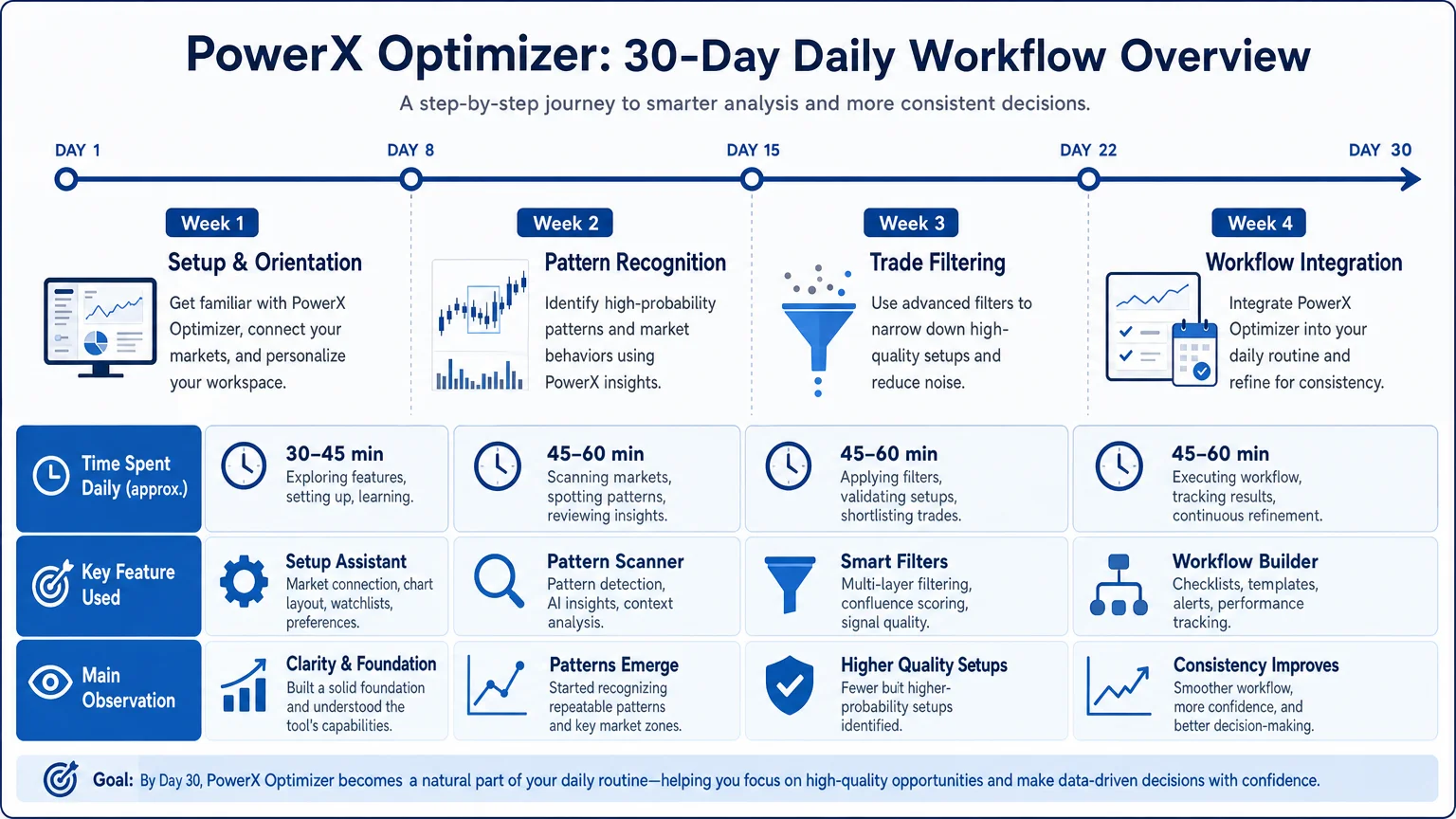
Over the course of a month, this process becomes routine. The scanner typically surfaces between five and twenty candidates on any given trading day, depending on overall market conditions. On high-volatility days, the list tends to be longer. During quiet, range-bound markets, the output thins noticeably. This variability is worth understanding upfront: the tool reflects market conditions rather than manufacturing opportunity where none exists.
One consistent observation is that the platform’s value is proportional to the user’s ability to interpret what it surfaces. A filtered list of ten stocks is only useful if the trader understands why those stocks appeared and what the suggested entry and exit parameters mean in practice.
How Does the Daily Workflow Hold Up Over 30 Days?
The honest answer is that the workflow holds up well for disciplined users and poorly for impatient ones. PowerX Optimizer is built around a specific trading philosophy — one that favors defined-risk options strategies and systematic entry rules. Traders who are willing to follow that framework consistently will find the daily routine manageable and repeatable.
Those who expect the software to adapt to their own pre-existing strategies, or who want to override the system’s signals frequently, will find friction. The platform is opinionated by design. That is a feature for some users and a limitation for others.
A useful comparison of how this workflow stacks up against a more manual platform is covered in PowerX Optimizer vs. Thinkorswim: A Side-by-Side Look, which examines the structural differences between a dedicated scanner and a full-featured brokerage platform.
What Are the Genuine Strengths Observed After One Month?
Structured screening saves time. The most tangible benefit after 30 days is the reduction in time spent manually scanning charts. Without a tool like this, a trader reviewing dozens of stocks individually each morning could spend an hour or more before identifying any candidates worth analyzing. The scanner compresses that process significantly.
Rule clarity reduces second-guessing. Because the system operates on defined criteria, there is less ambiguity about why a stock appears on the list. This does not mean every candidate is a good trade — it means the filtering logic is transparent and consistent, which supports more disciplined decision-making.
Educational framing is present. Rockwell Trading embeds educational context into the platform, explaining the logic behind the signals rather than just presenting outputs. For traders who want to understand the methodology, this is genuinely useful. Those looking for deeper foundational knowledge may also benefit from exploring the Financial Fortress Audiobook: What It Covers and Who It’s For, which addresses broader financial mindset alongside trading mechanics.
What Are the Honest Limitations?
No trading tool is without drawbacks, and one month of daily use surfaces several worth naming directly.
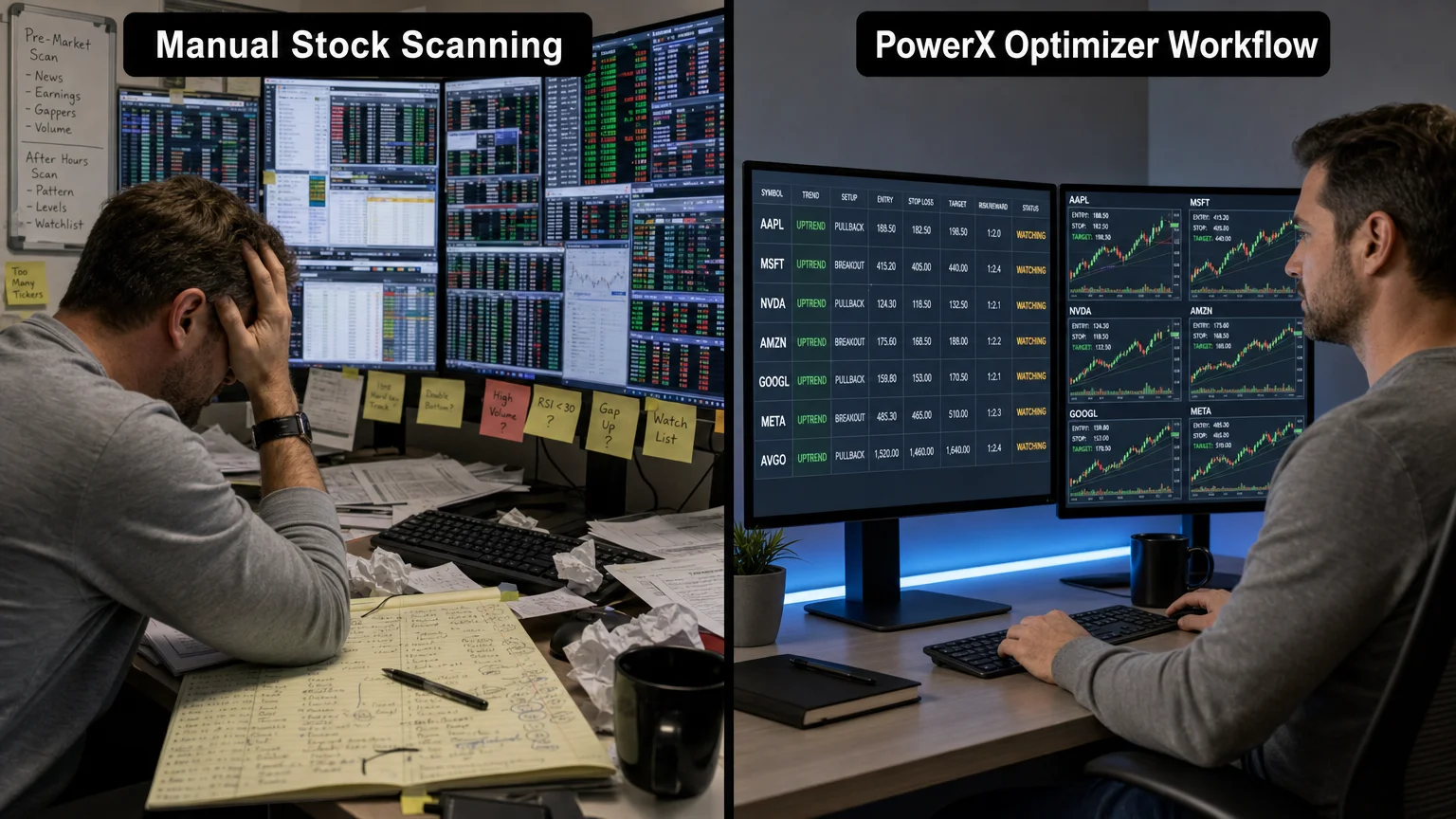
The output requires interpretation. PowerX Optimizer surfaces candidates; it does not execute trades or confirm that a given setup is appropriate for a specific trader’s account size, risk tolerance, or experience level. Users who treat the list as a buy signal rather than a starting point for analysis are misusing the tool.
Market conditions affect output quality. During trending markets, the scanner’s momentum-based criteria tend to surface more actionable candidates. During choppy or directionless markets, the list may be shorter and the setups less clean. This is not a flaw unique to this platform — it reflects the underlying reality of technical analysis — but new users may find it disorienting.
The learning curve is real for beginners. Traders without a working understanding of options mechanics, particularly defined-risk strategies like vertical spreads or covered calls, will struggle to act on the scanner’s output meaningfully. The platform assumes a baseline of knowledge. Supplementary education, such as what is covered in the Stock Trading Education resources on this site, is a practical prerequisite for many users.
Cost is not trivial. The subscription price warrants careful consideration relative to a trader’s account size and activity level. Verified pricing details are available at How Much Does PowerX Optimizer Cost? A Verified Breakdown.
Who Is PowerX Optimizer Best Suited For?
Based on 30 days of direct observation, the platform fits a specific type of user well:
| User Profile | Fit |
|---|---|
| Active trader comfortable with options basics | Strong fit |
| Trader seeking a structured, rule-based daily routine | Strong fit |
| Beginner with no options knowledge | Weak fit without supplementary education |
| Trader wanting full customization of screening criteria | Moderate fit — system is opinionated |
| Passive investor seeking long-term buy-and-hold ideas | Poor fit |
| Trader with very small account size | Consider cost-to-account ratio carefully |
The platform is not designed for passive investors, day traders seeking sub-minute signals, or traders who want to build entirely custom screening logic from scratch. For a broader overview of the tool’s positioning, the PowerX Optimizer Review: What It Does and Who It’s For provides additional context.
What Does One Month of Daily Use Reveal About Risk Management?
PowerX Optimizer includes suggested stop-loss and target levels as part of its output, which is a meaningful feature. Having predefined exit parameters built into the candidate presentation encourages traders to think about risk before entering a position rather than after.
That said, no software manages risk on behalf of the trader. The suggested parameters are starting points, not guarantees. A trade that meets all of the system’s criteria can still result in a loss — and frequently does, because that is the nature of trading. Anyone approaching this platform with the expectation that a scanner will protect them from losing trades will be disappointed.
For a clear-eyed overview of what trading risk actually involves, Stock and Options Trading Risk: What New Traders Must Know is essential reading before using any scanning tool, including this one.
Conclusion
One month of daily use with PowerX Optimizer produces a clear-eyed assessment: it is a functional, well-structured scanning tool that delivers on its core promise of reducing manual screening time and providing a repeatable daily workflow. It is not a trading system that removes risk, replaces judgment, or guarantees results. Its value is real but conditional — conditional on the user having sufficient foundational knowledge, the discipline to follow a rule-based process, and a clear-eyed understanding of what trading risk involves.
For traders evaluating whether this platform fits their current skill level and goals, the PowerX Optimizer Review: What It Does and Who It’s For is a logical next read. For those still building foundational knowledge, the Stock Trading Education section of this site offers a useful starting point.
Economics Savvy may earn a commission if you purchase through links on this page, at no additional cost to you. This article does not constitute investment advice. Trading involves substantial risk of loss.
Frequently Asked Questions
Does PowerX Optimizer tell you exactly what trades to make?
No. The platform surfaces stock and options candidates based on technical criteria and provides suggested entry, stop-loss, and target levels. The final decision to enter or exit any trade rests entirely with the user. It is a screening and decision-support tool, not an automated trading system.
How long does it take to use PowerX Optimizer each day?
Based on daily use, the core scanning and filtering process takes approximately 15 to 30 minutes on most trading days. That estimate assumes the user is already familiar with the platform's interface and methodology. New users should expect a longer orientation period during the first few weeks.
Is PowerX Optimizer suitable for complete beginners?
It is not the ideal starting point for traders with no prior knowledge of options mechanics or technical analysis. The platform's output assumes a baseline understanding of how options strategies work. Beginners are better served by building foundational knowledge first, then incorporating a scanning tool like this into their workflow.
Can PowerX Optimizer be used alongside a standard brokerage account?
Yes. The platform is a standalone scanner; trades are executed through a separate brokerage of the user's choosing. It does not require a specific broker and does not execute trades on the user's behalf.
Does using PowerX Optimizer guarantee profitable trades?
No software can guarantee profitable trades. Trading stocks and options involves substantial risk of loss, and past performance of any system or methodology does not guarantee future results. PowerX Optimizer is a tool for identifying candidates, not a guarantee of outcomes.
What kind of strategies does PowerX Optimizer focus on?
The platform is oriented toward defined-risk options strategies, particularly those that benefit from directional momentum. It is not designed for purely passive strategies, arbitrage, or high-frequency approaches.
Where can I find verified pricing for PowerX Optimizer?
Current, verified pricing details are available at [How Much Does PowerX Optimizer Cost? A Verified Breakdown](/blog/how-much-does-powerx-optimizer-cost-a-verified-breakdown/). Prices should always be confirmed directly with Rockwell Trading before purchasing.
Richard independently publishes Economics Savvy and has owned and used PowerX Optimizer since 2020. He shares first-hand observations about its workflow, features, limitations, and trading risk.